


Once upon a time, the most competitive fight in the tech world was Microsoft vs. Apple. You liked one or the other, and that was it. Mobile devices added Android vs. iPhone to the war. Microsoft is reviving that battle by adding a popular iPad feature to Office and will soon support Scribble.
Also read: How to Use Microsoft Office on Chromebook for Free
Scribble on iPad
Apple first added support for Scribble with iPadOS 14. This feature allows you to write with an Apple Pencil on an iPad, and your handwriting will instantly switch to typed text. It can be used to both add new text and edit existing text.
Some note-taking apps support Scribble and allow you to jot down notes with the Apple Pencil to be turned into text – but not all. Many third-party apps do not, in fact. Apple’s own Notes app does, but it’s hard to see in the screenshot below, as it transforms the handwriting so quickly that I couldn’t capture the screencap in time.
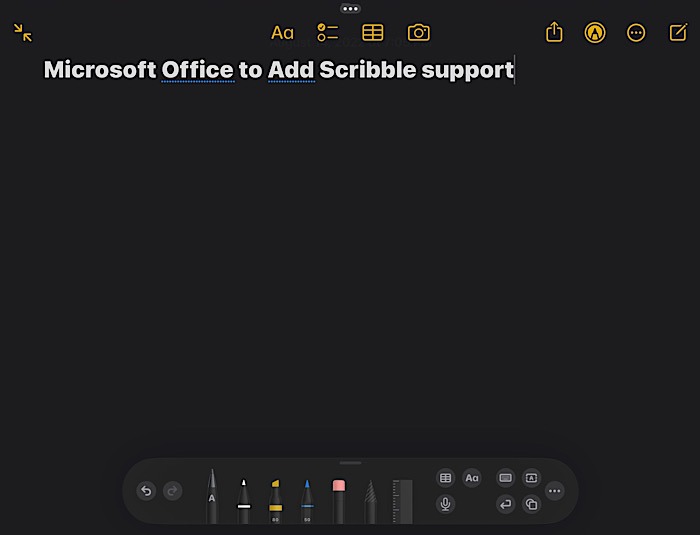
Scribble can be a real boon to writers. It helps me be more creative when I write, as it slows my process down slightly since I’m a fast typist.
However, it can also make some significant mistakes, as the AI doesn’t correctly recognize my handwriting. If you like the Scribble feature, you either have to stick with the Notes app or look around for a third-party app with support for handwriting to text.
Microsoft’s Announcement of Scribble Support
Perhaps Microsoft doesn’t like being left out. While you can take notes in Word in your handwriting, you can only use them in Draw mode, so your notes will stay in your handwriting, as seen in the image below.
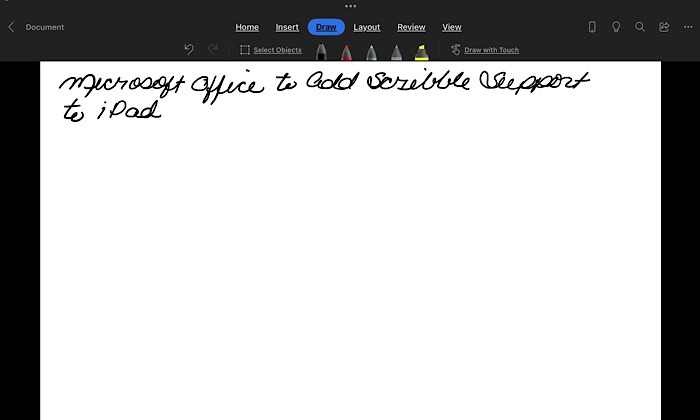
But that will soon be changing. Microsoft’s Office Insider Release Notes said that it now supports Scribble. However, I downloaded the Word app to try it out and found it is still not supporting the feature, as that image above shows.
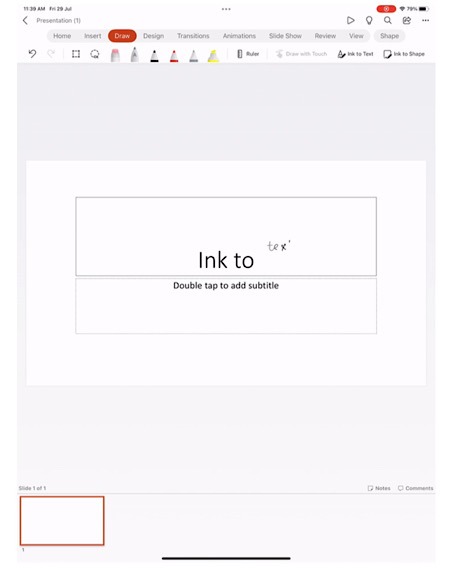
Assumably, Microsoft Word and the rest of the Office suite will soon be rolling out the feature. It will look something like the below image.
This is where I wonder whether Microsoft is competing with Apple again or just adding a very necessary feature. After iPadOS 14 added Scribble, Office users had to either switch to Notes or a third-party app that supported Scribble or do without it.
Not that Apple isn’t playing the same game. iPadOS 16 will have a new whiteboard app, Freeform, that will allow it to compete with some of its third-party competitors. I’m excited to try that out and see what options it has, but it’s been delayed. It’s not a part of the beta versions, and Apple says it won’t be ready until fall.
It’s always good to have choices, and Scribble is enough to make me try Microsoft Word again. I occasionally do when I’m looking for certain features, but it’s just not for me. Maybe I’m too much of an Apple person. I always return to Evernote, but it doesn’t support Scribble either – it just keeps your handwritten text as a drawing.
I want to note that while I’m mostly focusing on Word here, the other apps in Microsoft Office will also be getting Scribble support. To me, it just seems like it will affect Word users more.
I would have never thought mobile note-taking apps would be competitive. But if you’re looking for some options, consider one of these note-taking apps for iOS.
Image credit: Unsplash All screenshots by Laura Tucker