


Some time ago, Microsoft released a new version of their Edge browser. The main draw to this new Edge was that it was using a Chromium base, which – as the name suggests – shares roots with Google’s Chrome browser.
At the time, it was uncertain whether Edge would win over the masses. Fortunately, Microsoft made some good decisions with Edge, such as allowing the installation of Google Chrome extensions. This meant that people could make the jump without sacrificing their favorite extensions.
All this effort seems to have finally paid off, as Edge became the second most-used web browser behind Chrome.
How Well Is Microsoft Edge Doing?
You can see for yourself at Net Marketshare, a useful tool for analyzing browser popularity. At the time of writing, the browser usage for last month was Chrome at 67.95 percent, Edge at 7.49 percent, and then Firefox at 7.36 percent. This is pretty big, as Firefox has held the No. 2 spot for a very long time; seeing it fall to a newcomer in the space of a month is quite jarring!
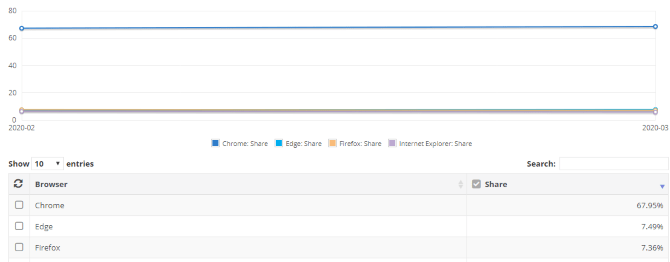
Of course, it’s not that much of a lead – it’s only 0.13 percent, after all – but the fact that Edge has managed to dethrone Firefox at all is impressive. This goes double when you realize that the new Chromium Edge came out in January 2020, which means people have flocked to this new browser by force.
Also read: Microsoft Edge (Chromium Version) vs Google Chrome
Why Did Edge Overtake Firefox?
Why did the all-time 2nd-place holder suddenly fall to Edge? The easy answer is that Edge is the new kid on the block, and its usage stats are due to people checking it out. It’s also valid to predict that people will move away from Edge once they grow tired of it.
However, there are signs that people actually prefer Edge to Firefox. For one, VentureBeat pitted Edge, Firefox, Chrome, and Brave against each other in eight benchmark tests. Edge took the trophy in four of those tests, while Firefox won two and Chrome only one.

People are also eating humble pie after years of IE and old-Edge mockery. There are Reddit threads spread around the Edge, Chrome, and Firefox subreddits of people giving praise to the new browser. Some are sticking to their guns but are giving props to the new browser and appreciating how far Edge has come.
As such, it’s hard to tell if Edge’s stats are due to people giving it a short-term trial to see what the fuss is about or if people are making a serious commitment to using it. We’ll have to wait through the coming months to see where Edge’s statistics go and if it can hold its title as the No. 2 browser on the Internet.
Edging Ahead of the Competition
While Edge still has a long way to go to compete against Chrome, it has already managed to overtake Firefox as the second most-used browser last month. Whether this is simply a boost from the new Edge’s novelty or a serious commitment is yet to be seen.