
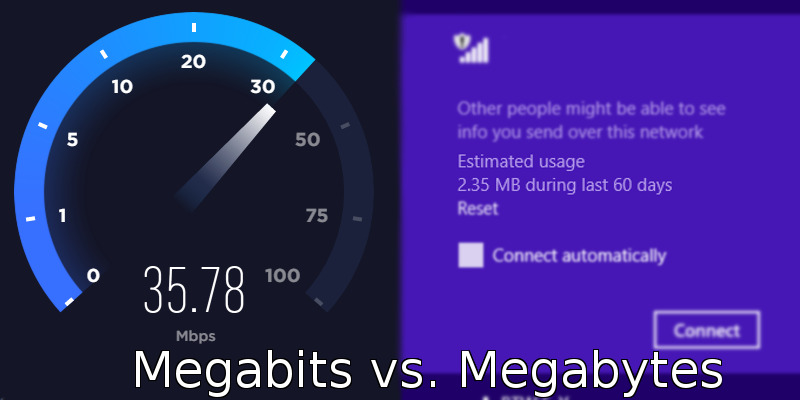

As more and more of our daily entertainment comes from online sources, Internet speed has become a very important factor. In a world where people can legally download movies and stream television shows from their PCs, users don’t want to sit about and wait to watch their shows. Because of that, when buying a new broadband package, users are keen to know just how fast the connection will be. Unfortunately, this comes with its own little conundrum, which is the issue of megabits vs. megabytes.
The Problem
Let’s say you’re interested in getting a new Internet service. You look at the speeds being offered spy a package that advertises speeds of “up to 50Mbps”. If you purchase this package, how fast do you think your download speeds would be?

It’s easy to assume that “Mbps” stands for “megabytes per second” and that if you bought this package, you’d be able to download files at 50MB per second. However, take a close look at the advert above. You’ll notice it advertises the speed in “Mbps,” and the speed is “up to 50Mbper second.” Add this to the fact we write megabytes as “50MB.” The lower-case “b” in this example is very important, as it shows we’re not talking about 50 megabytes per second. This Internet speed is actually being advertised at 50 megabits per second, which is a lot different!
The “Real” Speed
So if we’re not going to be downloading at 50 megabytes per second, what will 50Mbps get you?
In order to answer this, we need to look at megabits vs. megabytes. To do this, it’s easier if we cut off the “mega” from both sides and compare the difference between a bit and a byte. A byte is comprised of 8 bits, so we can say that a byte is 8 times larger than a bit, or mathematically, 1 byte = 8 bits. If we use this information on our megabits and megabytes problem, we can see that a megabyte is 8 times larger than a megabit, or 1 megabyte = 8 megabits.

Now that we know this, we can work out how fast 50 megabits per second will be in megabytes. Given how there’s 8 bits to a byte, we can take the 50Mbps value and divide it by eight. This gives us 6.25, which means we’ll be downloading at a speed of 6.25 megabytes per second. That’s a lot slower than we first assumed!
This is why it’s so important to understand the difference between megabits and megabytes. What looks like a fantastic deal suddenly becomes eight times worse after you’ve signed the contract. If you want to tell if a company is using megabits or megabytes, it’s easy to distinguish between the two. Just remember that megabits use a lowercase “b” (Mbps) while megabytes use an uppercase “B” (MBps).
Why Use Bits? Why Not Bytes?
But why are we using bits in the first place? Wouldn’t it be so much easier if companies just advertised their speeds as megabytes and stopped all this confusion?
As an explanation, there are quite a few out there, including megabits being more favourable from a marketing standpoint (50Mbps looks more impressive than 6.25MBps). However, the most reasonable explanation is that it’s just how network communications speeds have always been measured. Bytes are typically used when we’re calculating storage and size (500GB hard drive, 10MB file), while bits are used when we’re discussing how fast a connection is (50Mbps Internet).
In fact, we’ve been measuring network activity in bits since the first modems were invented over half a century ago! This was obviously at a time where people weren’t worried about streaming their favourite TV show on Netflix but simply cared about the speed at which one device could communicate with another. As such, when an Internet provider tells you a speed in Mbps, they may simply be using the standard that has been used since the invention of modems.
Why the Speed Isn’t Guaranteed
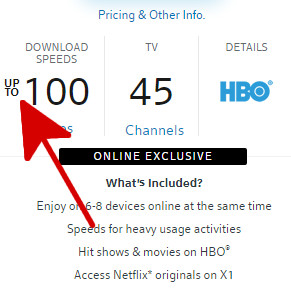
Even after all this calculation and working out what your download speed will be, it might not be perfect. If you look carefully, you’ll notice that service providers advertise their connections as “up to” the figure they advertise. This is due to a wide range of variables, such as your distance from the ISP, the amount of people using the Internet at the time, and how well the ISP maintains their service.
In short, it means you’re not guaranteed to always get the speed you purchase. Be careful when buying a new Internet package, and be sure to read reviews to check if the company makes good on their promise of advertised speeds. For streaming online movies, such as on Netflix, it will help if you know how to improve the Internet speed, too.
A Bit of Help
When looking for a new Internet service, it can be hard to tell what the ISPs are selling you. While confusing on first sight, the issue of megabits vs. megabytes is very simple once broken down. Just remember that 1 megabyte equals 8 megabits, and you won’t get stuck on Internet speeds ever again.
Has the megabyte/megabit similarity caused problems for you or someone you know? Let us know your stories below.