
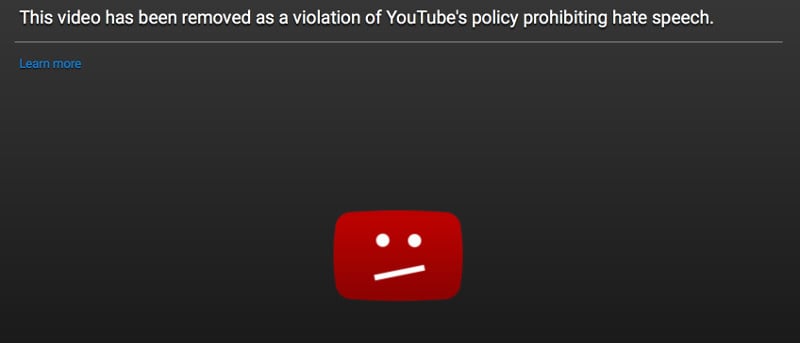

On 9 May 2016, a report appeared on Gizmodo revealing that Facebook employees were “curating” the trending feed by removing content that would be appealing for politically conservative members of the site. Later the same month, major players in the tech industry agreed voluntarily to enforce the EU’s hate speech rules.
Attempting to police the Internet is no longer a phenomenon that occurs in a country far away from the North American/European bubble. While many consider these actions the diminution of an individual’s freedom of expression, this is a discussion best held in another context at another time. The question I am setting out to answer is whether it is practical to attempt to police speech on the Internet, whatever form this kind of action may take.
Television and Radio vs. Internet

Radio band-based broadcasting, both on television and radio, was the key form of entertainment and information during the period where the majority of the Eastern Bloc fell under various forms of authoritarian regimes. They were relatively easy to police due to the fact that each channel would broadcast all of its content in one single steady stream (Romania, for example, broadcast its content through Televiziunea Român for only two hours of the day during the 80s). Of course, there were attempts (with various measures of success) to break into the Iron Curtain through projects such as Radio Free Europe which would broadcast Western content through various frequencies in different nations. But, for the most part, the regimes of Eastern Europe kept a relatively ironclad grip on broadcast content until the civil unrest of the late 80s and early 90s.
The Internet – in contrast to these forms of “infotainment” – has a vast array of websites, a mind-numbing amount of networks, and vast oceans of information out of the reach of conventional search engines. Attempts to police the Web in various countries have failed mostly because there are many ways people could easily circumvent the political barriers that prevent them from reaching the outside world. I’m not saying that it is impossible to police the Web, but it certainly carries an immense cost and would never be able to account for the constant stream of new workarounds developed by an army of programmers dispersed across various continents. It was easier to police content when all it took was a skilled graphologist to catch a journalist using a registered typewriter.
Exploring the Nuances

Although it is theoretically possible to compare Facebook’s news curating and the EU’s latest move to curb what it defines as hate speech to other national attempts to curb free expression on the Web, there’s an important distinguishing factor between the two. On one hand we have private companies signing into a massive effort to eliminate certain types of speech and curate content. On the other there’s a state entity cracking down on individual expression in a top-down manner. The reason it’s important to make this distinction is because Facebook, Microsoft, Google, and Twitter are all private entities entering into an agreement without the force of the law. There are alternatives to all of these companies, however unpopular they may be.
The Rundown
Curbing and policing speech isn’t a new phenomenon. It’s been tried back in the days when radio and television were the only widely-used mediums for broadcast information and entertainment. Even in simpler days when policing telecommunications was easier, it still required some effort to suppress external sources (especially on FM/AM radio). In an era when the Internet – with its countless arrays of cliques, discussion forums, online publications, and an entire planet of spectators – is the intermédiaire du jour for communication, policing its content and what people see (i.e. attempting to cartelize media) is a near-impossible task.
Let us know what your thoughts are on this. Is the Internet worth policing? Should it be policed? Tell us in a comment!