
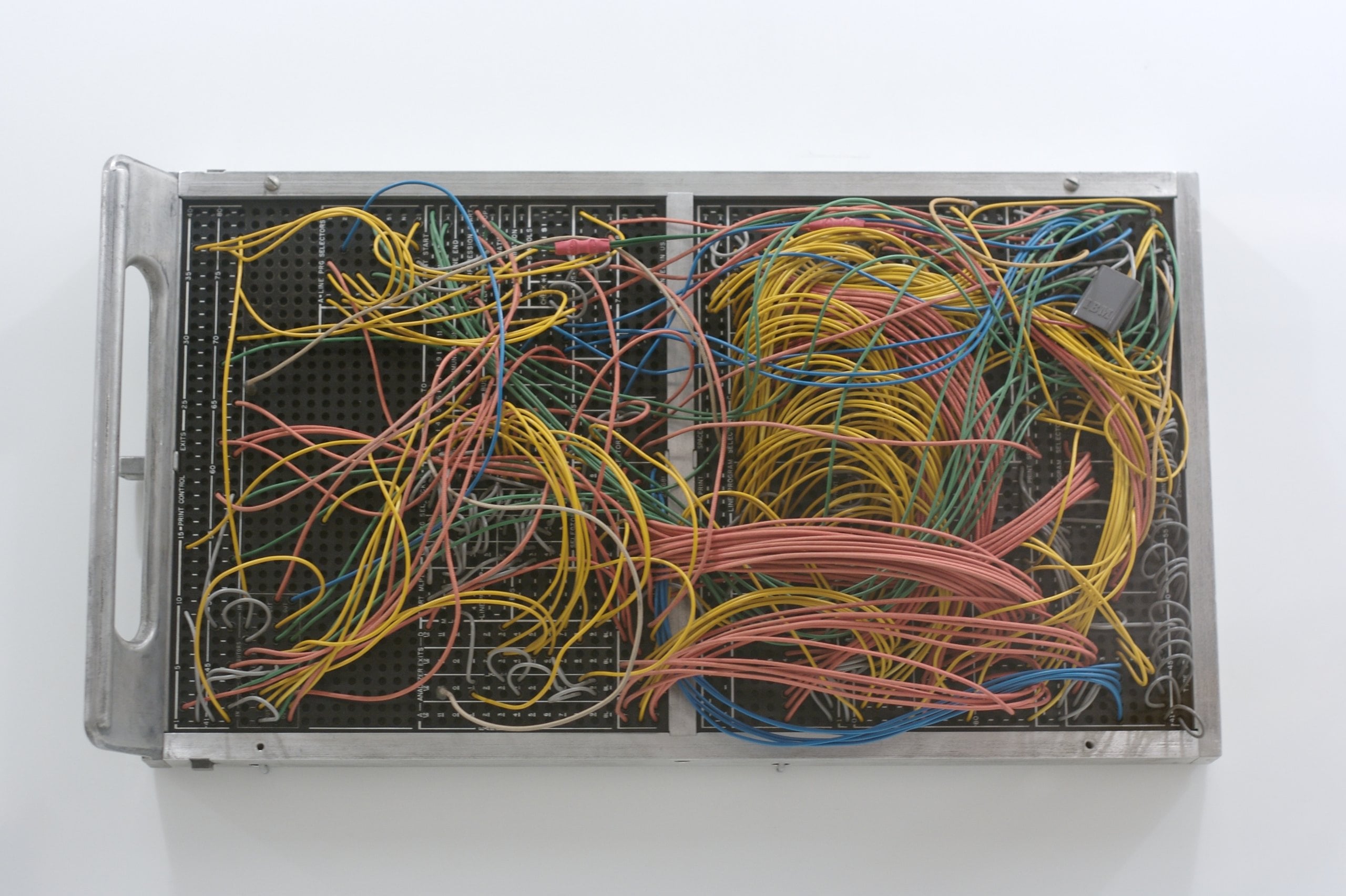


Random-access memory was not a new idea when IBM’s engineers started work on it. According to IBM’s history page on RAMAC, every earlier attempt was too slow to be practical, and retrieving information through a computer took hours or even days.
IBM had sent a group of engineers to a new lab overlooking a plum orchard in California in 1952. Their task was to study how computers accessed data, which at the time meant running a stack of punched cards through a machine and shuffling through the data.
Reynold B. Johnson, who later became an IBM Fellow, led the team. The machine they built, the IBM 305 RAMAC, appeared in 1956, which makes 2026 its 70th anniversary.
The baloney slicer
The engineers tried rods, strips, tapes and flat plates before settling on aluminum disks coated with iron oxide paint. Magnetic spots on each disk stood for characters of data, and a magnetic arm, which IBM likens to a record-player needle, read the spots as the disks rotated.
IBM says the disks needed to be strong, absolutely flat, and light enough for a motor to rotate them. In the first trials they warped at high speed, so the researchers glued two disks together.
The arm could not touch the disk without destroying data, so the team built a version that blew out compressed air to keep it hovering above the surface.
A single disk could not hold enough data to be useful.
So the team stacked 16 disks horizontally. IBM executives who doubted the design called it the “baloney slicer”. The last problem was getting the arm to the right track on the right disk quickly. “We achieved something like 800 milliseconds, and that’s where the product came out,” Johnson said.
Five megabytes, more than a ton
The finished system held 5 million characters at 7 bits per character. IBM’s page gives the capacity as “a mere 5 megabytes” in one place and as 5 to 10 megabytes in another, and compares it to a few MP3 files.
The machine was the size of two kitchen refrigerators and weighed more than a ton.
The researchers formed the name from “random-access memory” and the “AC” ending of the UNIVAC computer, which was popular at the time. Marketers later changed the suffix to stand for “accounting and control”, since early demand came from businesses that needed real-time accounting. IBM described the process at the time as “miracle memory”.
Early customers included 3M, New York University, Norfolk Naval Shipyard, Pfizer and United Airlines. Within two years the United States Custom House was using RAMAC to monitor Atlantic Ocean traffic, cutting the response time to ship distress calls to five minutes.
In 1958 RAMAC was shown in the US pavilion at the Brussels World’s Fair.
During the 1960 Olympic Games in Squaw Valley, California, 36 IBM employees staffed a center that provided electronic data processing for scoring. Scoring calculations had previously been done by hand and could take hours. RAMAC did the job in minutes.
Sources:
- IBM, RAMAC (IBM history): https://www.ibm.com/history/ramac