


Google has become synonymous with search. The name has become an action. Who searches for things online? We google it. It’s come a long way since it was first developed in 1997 – when that’s all Google was, a search engine. Google has recently added more AI to search to make it even more helpful.
Google Search Updates Using AI
Google says on its blog that “at the heart of Google Search is our ability to understand your query and rank relevant results for that query.” Last year BERT language was introduced for more relevant search results, and now it’s being used in nearly every English query to help get higher-quality results.
Spelling
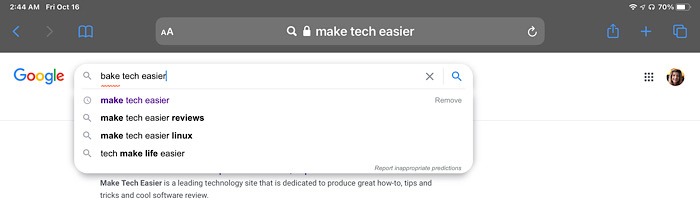
Google has always corrected us and asked if we meant a more correctly spelled entry, as one in 10 queries is misspelled. A new spelling algorithm uses a deep neural net to improve the ability to decipher spellings. You can see in my image below that the AI knew I meant “Make Tech Easier.”
Passages
With Passages, you can better search for specific phrases. It’s hard to find that one sentence you’re looking for. You Google for it, but it’s finding all instances of the single words. Instead of only indexing webs page, now passages will be indexed as well. Google estimates the search queries are improving by seven percent.
Subtopics
To dive even deeper into your topic, Google has applied neural nets to deliver subtopics around an interest. Google’s example is searching for “home exercise equipment.” It will then suggest the relevant subtopics of “budget equipment,” “premium picks,” or “small space ideas.” That change will be rolling out by the end of the year.
COVID-19 Information
Google has made several improvements to help get information that will keep you safe. It’s added live busy-ness updates for businesses to tip you off about crowds. Safety information is at the forefront of Business Profiles on Google Search and Maps to know whether you will be required to wear a mask or make a reservation and whether the staff is taking extra precautions. Information will be kept up to date, such as hours of operation and store inventory.
Understanding Important Moments in Videos
With a new AI-driven approach, Google Search can now understand language more deeply. It’s used to tag key moments in a video. Google compares it to navigating chapters of a book. That funny moment you want to find on a video, Google will find it for you. No more flipping through multiple videos looking for that one segment.
Deeper Understanding of Data
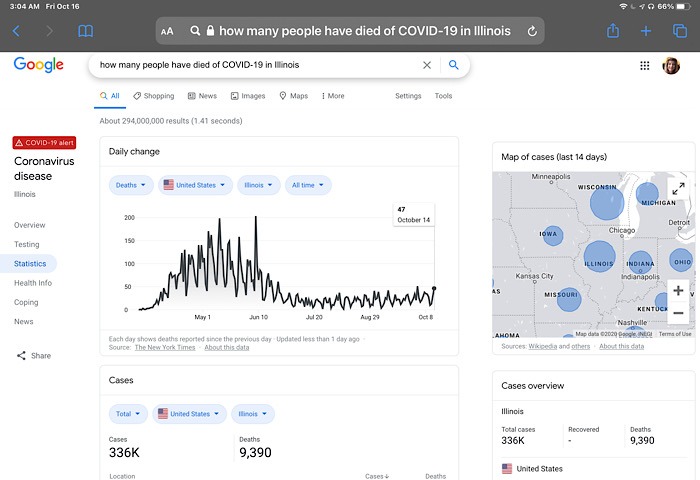
Going off the COVID-19 information from earlier, I tried searching for how many people have died from COVID-19 in my state of Illinois. I was shocked at what came up. No paragraphs or statement telling me. I got that image above. That’s exactly what I wanted to know! This is something Google has been working on for a few years.
Journalist Studio
There are also new search tools for journalists. As a news writer, I can’t tell you how Google Search has become my old friend over the years. It could become a better friend. Journalist Studio offers a few tools to help journalists flips through the large collections of documents, images, audio, etc. That could become a very welcome addition. It’s free, but you have to sign up for the service.
3D and Identifying Songs
Changes to Lens and AR in Google Search will help you see the world in a whole new way as you learn, shop, etc. You can get step-by-step homework help and can virtually shop more easily while still social distancing. Also, you can now hum a song, and Google will identify it. However, I couldn’t get it to work, and since only Android was mentioned, I’m guessing that it’s something that hasn’t rolled out to iOS yet.
Say what you want about Google (and you will …), but they are continuously changing, usually for the better. The changes Google made to Search with AI aren’t game-changers, but there’s no doubt Google will continue trying to improve
If Google added too many changes, and it’s no longer what you’re looking for in a search engine, try one of these alternatives for Google Search.