

There’s more exciting gaming hardware on the horizon than the PS5 and the Xbox X and S. It’s fast gaming at CES 2021, with an Asus gaming laptop billed as the world’s fastest laptop display. Once you take that step, you can also add a Brink Bionics controller that you wear like a glove.
Asus ROG Strix Scar 15
ASUS’s fast gaming entry at CES 2021 is the ROG Strix Scar 15. It delivers both a 17-inch and 15-inch model. The 17-inch will have a 1920 x 1080 pixel IPS-level panel and 360Hz refresh rate. This includes a three-millisecond response time and 100 percent sRGB color gamut coverage. Asus says it’s the fastest display on a laptop, and that should be enough to excite the gamers.
It also comes with a 2560 x 1440 pixel high-resolution panel with up to 165 Hz refresh rate, three millisecond response time, and 100 percent DCI-P3 color gamut coverage. Both options are offered on the 15-inch as well.
Other features include an AMD Ryzen 7 5800H or Ryzen 9 5900HX processor, Nvidia GeForce RTX 3070 with 8GB VRAM or 3080 with 16GB VRAM graphics, up to 64GB dual-channel DDR4 3200MHz SDRAM memory, and 1TB M.2 NVMe SSD storage.
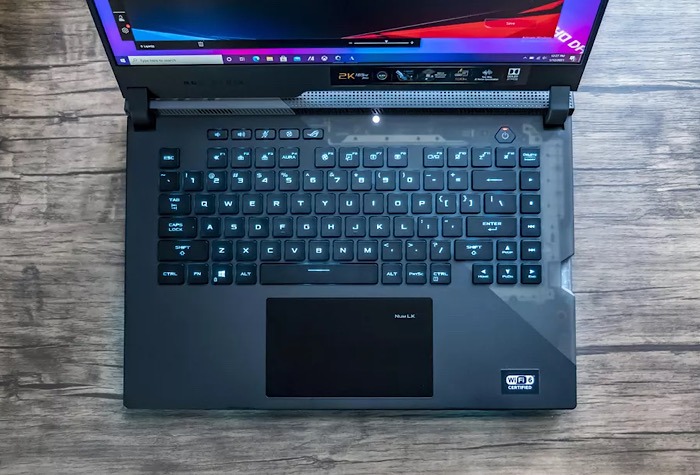
The Asus ROG Strix Scar 15 is not just about fast gaming – it’s aimed specifically at esports, even down to the design, inspired by athletic wear. The laptop body is smaller than its predecessor and has a slimmer frame and increased screen-to-body ratio. RGB lights on the front light up, showing the logo on the lid.
The keyboard is built inside a translucent dark gray outer shell, allowing you to see some of the components inside. RGB lighting is included in the optical-mechanical keyboard that has a 0.2 millisecond response time, with the keys having a 1.9 millimeter travel. The larger laptop has a number keypad, while the smaller one has an Asus NumberPad touchpad. Press the Num Lock key and the touchpad illuminates and becomes a number pad.
Brink Bionics
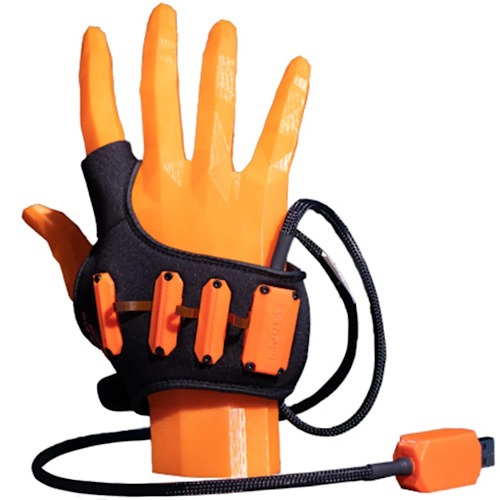
A new player has also shown up to add to the fast gaming picture. After running a campaign at Kickstarter, it’s now on IndieGoGo. Brink Bionics is bringing the Impulse Nuero-Controller, which is worn on your hand like a glove. It recognizes mouse clicks before you even finish clicking the button.
The Impulse “glove” is fingerless with sensors. The signals sent by the user’s muscles when they begin to click the mouse are picked up by the controller. Software processes these signals and interprets them as clicks. It’s said to save 80 milliseconds on the clicking time.
“This is the first time that the human nervous system has been leveraged to optimize performance for gaming and e-sports in real time,” said creator Erik Lloyd. “It’s the first step toward futures portrayed in games like Deus Ex or Cyberpunk, where you can walk into a store and purchase technologies that can optimize your natural abilities through neural interfaces.”
He added that his device changes the ways accessories operate. It transforms them into reactive devices. He compared how it could improve a user’s gaming by equating it with jumping from a 30 fps monitor to a 60 fps monitor.
The Indiegogo campaign was started for “anyone who missed our initial campaign.” Each controller costs approximately $140. Shipping is expected to begin in May.
Along with fast gaming laptops, CES is featuring many other products. It’s a good year for it, as the industry is expecting more growth this year because of the global health crisis.
Image Credit: Josh Goldman/CNET, Impulse IndieGoGo campaign, and public domain