
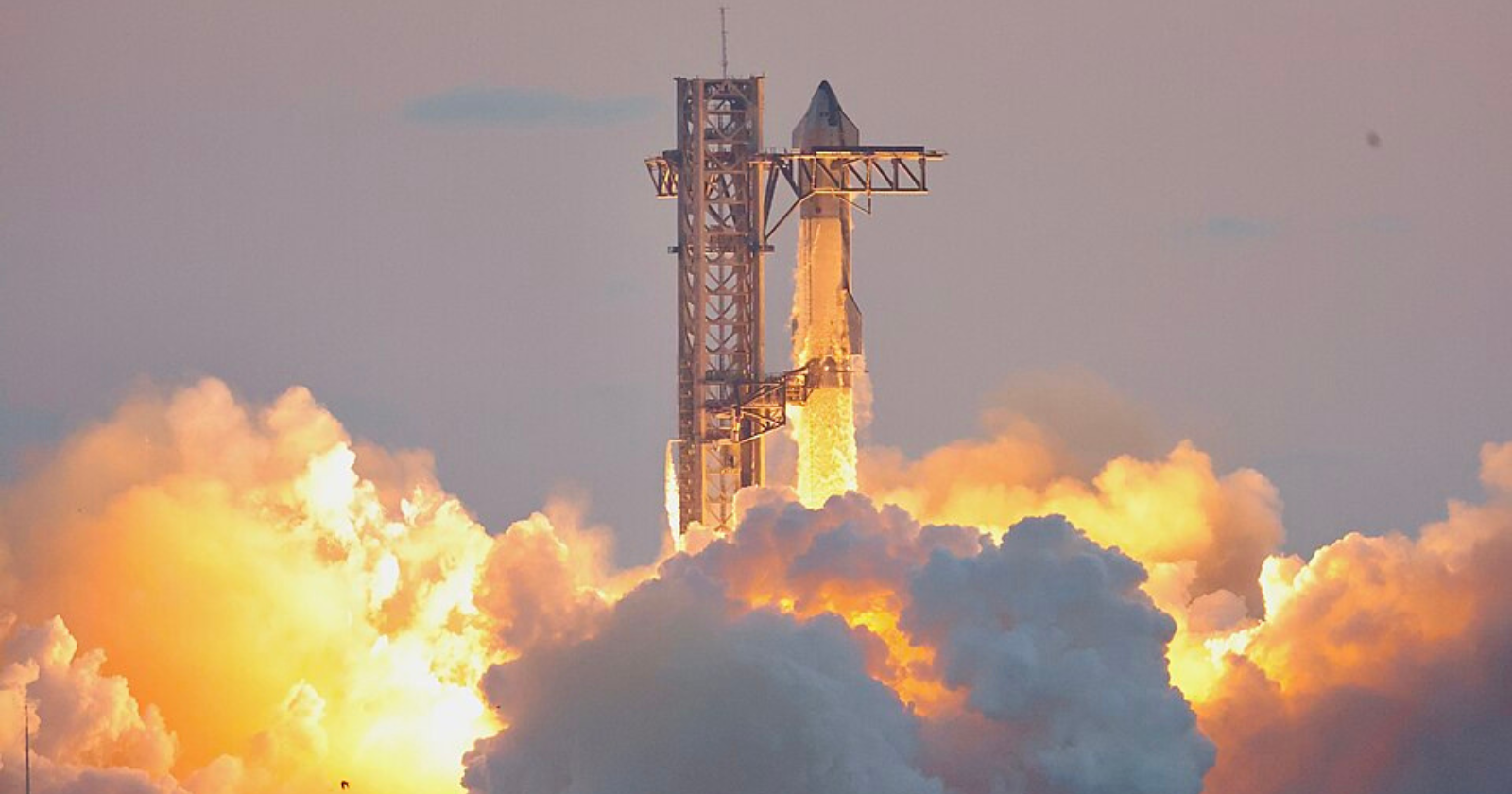

Every Starship upper stage that SpaceX has ever launched has ended its flight the same way: in the sea. Some splashed down gently in the Indian Ocean after successful test flights. Others broke apart along the way and rained debris into the water.
SpaceX now wants to change that. On its next flight, the company plans to bring the giant upper stage all the way back to its launch site in South Texas and have the launch tower grab it out of the air with a pair of huge mechanical arms. If it works, that ship could eventually fly again.
Two stages, one reusable dream
Starship is the largest and most powerful rocket ever built. It has two parts: a giant first-stage booster called Super Heavy, and an upper stage known simply as “Ship,” which is about 171 feet (52 meters) tall. The Ship is the part that goes to orbit and carries satellites, cargo and, one day, people.
SpaceX’s goal is for both stages to be fully and rapidly reusable, like an airliner. Its smaller Falcon 9 rocket already reuses its first stage routinely, landing it on legs, and that has dramatically cut launch costs. But Falcon 9’s upper stage is still thrown away on every flight. Starship is designed to reuse everything.
The tower that catches rockets
SpaceX already does part of this. In October 2024, on Starship’s fifth test flight, the launch tower at Starbase, Texas, caught a returning Super Heavy booster for the first time. The tower, nicknamed “Mechazilla,” uses two enormous arms, often called “chopsticks,” that close around the booster as it hovers beside the tower.
Catching a rocket instead of landing it on legs saves weight. Every pound of landing gear is a pound that can’t be used for fuel or cargo. It also means the rocket ends up right back on the launch mount, ready to be inspected, refueled and stacked again, without having to be trucked or shipped back from somewhere else.
So far, though, the Ship has never been caught. As of mid-October, Starship had flown 14 times, and every upper stage ended in the ocean.
Why catching the Ship is much harder
The booster only goes up a few dozen miles and turns back early, so it returns relatively slowly. The Ship is a different story. It travels at orbital speeds, around 17,000 mph, then has to slow down by plunging back through the atmosphere.
That reentry produces intense heat, so the Ship is covered in thousands of heat shield tiles. Any damage to them can let hot plasma get into the structure. As Space.com explained, the upper stage comes back from much greater heights and at much higher speeds than Super Heavy, which makes a catch far more demanding.
Then comes the tricky part. The Ship falls belly-first through the atmosphere, using flaps to steer like a skydiver. Close to the ground, it has to relight its engines, flip upright and slow to a near hover beside the tower, precisely enough for the arms to grab it. Getting all of that right, after a trip to orbit, is a big step beyond catching a booster.
The plan for Flight 15
Starship’s 14th flight, on September 28, 2026, was a major milestone. It was the first Starship to reach orbit and deploy working Starlink satellites. Earlier flights had also shown the Ship could survive reentry and make controlled splashdowns.
On the back of that progress, Elon Musk has said SpaceX will try to catch both the booster and the Ship on Flight 15, which he expects to fly in November. The company also released a simulation showing both stages returning to the tower. Musk has said the first reflight of a Starship upper stage could come around the end of 2026 or early 2027.
It’s worth keeping some skepticism handy. SpaceX originally talked about attempting a ship catch on Flight 14, and that plan was pushed back. Any catch also needs approval from the Federal Aviation Administration, since it means bringing a vehicle back from orbit to land near people and property. And SpaceX hasn’t yet set a firm launch date.
Why it matters
If SpaceX can reliably catch and refly the Ship, the cost of getting things into space could fall sharply. Rockets are expensive to build, and throwing them away after one use is like scrapping a jet after a single flight. Fully reusing both stages is the key to SpaceX’s plans for launching huge numbers of satellites, refueling ships in orbit, and eventually sending crews to the Moon and Mars.
NASA has a stake too. A version of Starship is meant to land astronauts on the Moon under NASA’s Artemis program. That mission depends on refueling Starship in orbit, which will take many launches in quick succession. Doing that affordably requires ships that can be flown again and again.
A first try, not a guarantee
SpaceX is known for testing hard, failing publicly and iterating fast. The first booster catch worked on the first attempt, which surprised many people, but the Ship is a much harder problem. Musk himself has put the odds of a first-try success at around 50 to 60 percent.
Either way, the next Starship flight will be one to watch. If the arms close around a ship that has just been to orbit and back, it will be a first in spaceflight history, and the beginning of the end for upper stages that finish their lives at the bottom of the sea.