
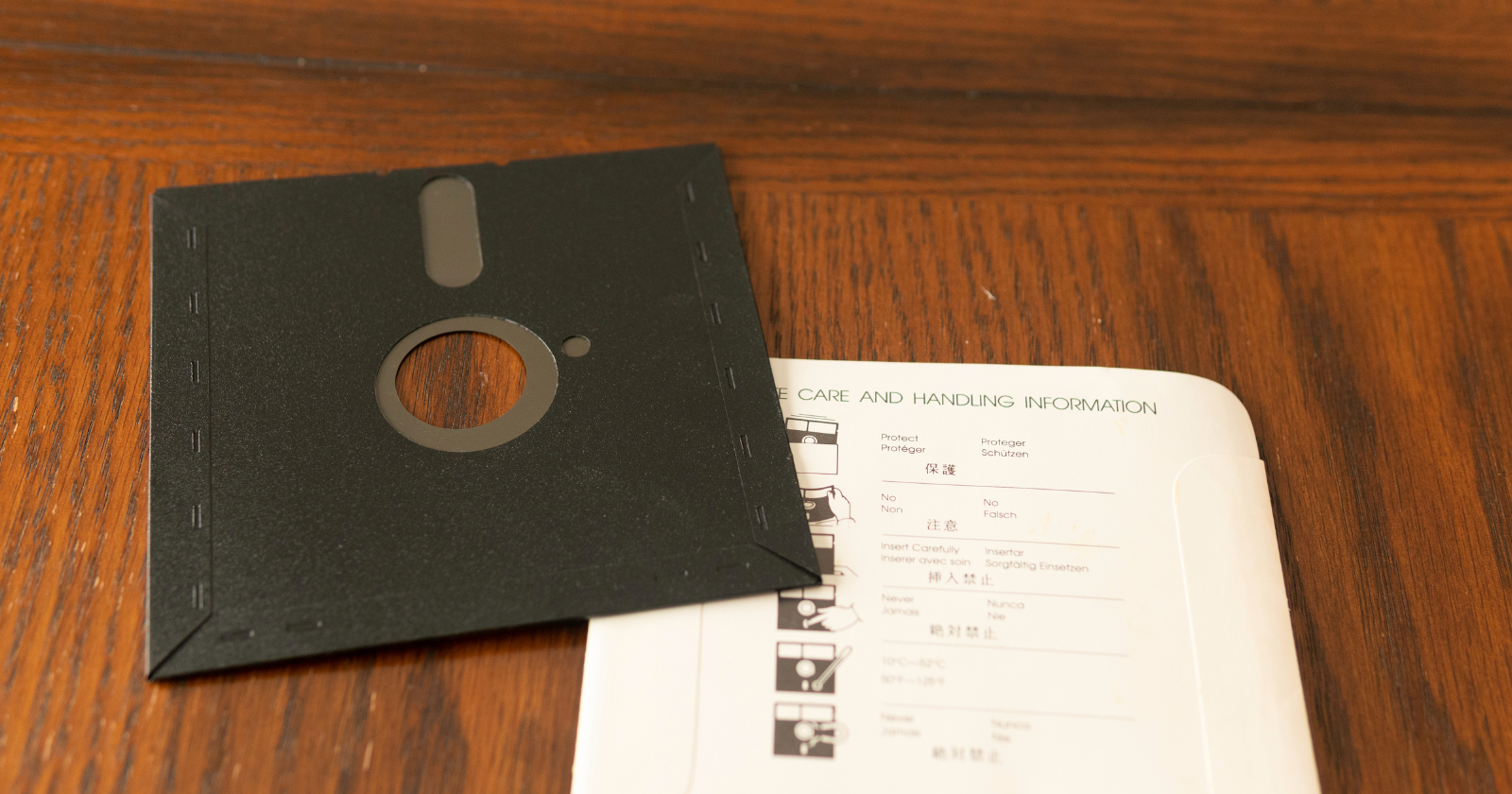

A short train ride from the campuses building the world’s most advanced AI, someone slots a floppy disk into a drive to start the trains.
Not a modern disk — a 5.25-inch floppy, the big, genuinely floppy black square that predates the hard plastic ones millennials remember, a format the industry abandoned decades ago. Three of them, loaded every single morning, to boot the DOS software that runs the Automatic Train Control System beneath Market Street. This is how San Francisco’s Muni Metro subway has started its day since 1998, in the shadow of Silicon Valley, using technology two generations older than the smartphone in every rider’s pocket.
A daily ritual from 1998
The system is called ATCS, and it does something genuinely important: while a Muni train is in the subway, its onboard computer hands control over to the central system, which drives the train automatically while the human operator supervises. Once the train surfaces onto San Francisco’s streets, it disconnects and the operator takes the wheel by hand.
That automated core runs on software that cannot simply be left running. Every morning, staff load three 5.25-inch floppy disks to feed the DOS program into the system’s central servers. Miss a step, corrupt a disk, and the subway’s brain doesn’t wake up. It is a launch ritual for a modern metropolis’s transit spine, performed with 1980s office supplies.
Slower than the modem you threw away
The floppies are only half of the antique. The trains and the servers talk to each other over “loop cable” — wire loops laid along the track, a wireless data method from the 1980s.
Its performance is almost comically poor by modern standards. Officials say the system moves data more slowly than a dial-up modem, and with less power than a modern cell phone. That means the trains can only exchange thin dribbles of information, the loop cable is fragile and easily disrupted, and — crucially — the whole approach can’t be extended beyond the subway tunnels. It’s a big reason Muni trains lose automatic control the moment they reach the surface: the technology simply can’t reach out there.
For a while, that was merely embarrassing. Lately it has become dangerous.
The clock that already ran out
Here’s the part that turns a quirky story into an urgent one. The ATCS was engineered in the 1990s with an expected service life of 20 to 25 years. That clock ran out around 2023. The system is now working past its own designed expiration date.
The specific fear is the disks themselves. Floppy disks degrade — the magnetic media literally decays over time — and Muni’s own officials have warned that continued reliance on them raises the risk of “a catastrophic failure” of the subway’s control system. On top of the physical rot, there’s a human problem: the system runs on 1990s programming languages, and the agency has to keep finding technicians who still know how to work with obsolete code and hardware. Every year, that expertise gets rarer, and Sony stopped even manufacturing floppy disks back in 2011.
San Francisco is not entirely alone — a handful of Boeing 747-400 jumbo jets still received navigation-database updates via floppy disk into recent years — but a major subway is a conspicuous place to still be doing it.
The $212 million goodbye
In October 2024, after years of planning and an 18-month delay courtesy of the pandemic, the SFMTA board approved the fix: a $212 million contract with Hitachi Rail — the company behind Japan’s bullet trains — to rip out the floppy-and-loop-cable system and replace it with a modern one using Wi-Fi and cellular signals to track trains precisely.
That $212 million is itself only part of a roughly $700 million overhaul of the Muni Metro’s controls, with the new system due to come online around 2027-2028. And it will do more than retire the disks: because the modern system isn’t shackled to buried loop cable, it will finally be able to control trains on the surface streets too, not just in the tunnels — something the 1998 setup could never manage. Muni officials describe the Hitachi system as five generations ahead of what they have now.
There’s a lesson in the price tag that goes well beyond one transit agency. The floppy disks weren’t kept out of nostalgia; they were kept because the system worked, and replacing critical infrastructure that still functions is expensive, disruptive and easy to defer — so it gets deferred, year after year, until the technology is older than the engineers maintaining it. The bill doesn’t disappear while you wait. It grows, quietly, until a subway that runs beneath one of the richest tech regions on Earth is booting off disks its own riders have never seen, and the catch-up costs a fifth of a billion dollars. San Francisco isn’t paying $212 million for new trains. It’s paying it to finally stop loading the old ones by hand every morning.