
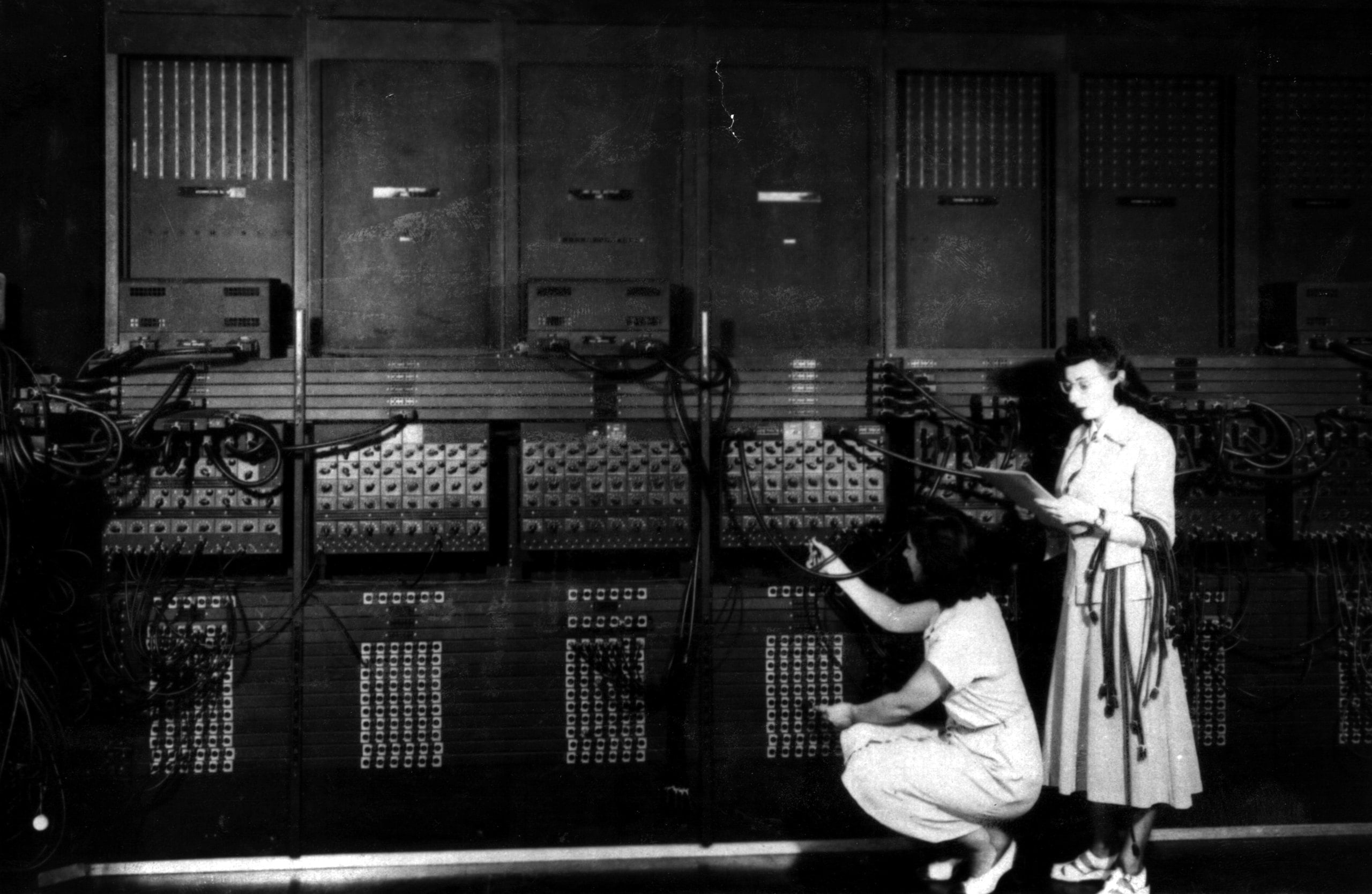


The hardest part of running ENIAC was keeping its vacuum tubes alive. “The chief challenge was tube reliability in the operation of ENIAC,” says Penn Engineering’s history page, and J. Presper Eckert got good reliability by running the tubes at one-quarter power.
The machine was built at the University of Pennsylvania’s Moore School of Electrical Engineering and announced on 14 February 1946.
John Mauchly and Eckert met at the Moore School during the war. Mauchly, a college professor, had enrolled in a government-funded wartime training course there and was later hired at Penn to replace staff called to active duty. Eckert, a Penn graduate, ran the course laboratory. Development began after a contract from the military’s Ballistics Research Laboratory.
A quarter of the power
Penn’s page describes Mauchly as the visionary behind ENIAC’s use of mechanical and vacuum tube technologies, and Eckert as the engineer who solved its technical problems. The tube problem was his to fix, and the fix was to run every tube at one-quarter power.
A vacuum tube worked as a switch by controlling the flow of electrons. The same parts were common in early radio and television sets. Faster switching meant a faster computer, since computers of the time depended on those switches.
ENIAC drew 150 kilowatts of electricity and had its own dedicated power lines.
18,000 tubes, or more than 17,000
Penn Engineering’s history page puts the tube count at 18,000, more than 20 times as many as the total used by all the systems aboard a wartime B-29 bomber. A later Penn Engineering story, published on 16 February 2026 for the machine’s 80th anniversary, says more than 17,000.
The rest of the hardware was on the same scale. ENIAC occupied a room 30 by 50 feet and weighed 30 tons. Its 40 panels were arranged in a U-shape that measured 80 feet long at the front, and its circuits held 500,000 soldered joints, 70,000 resistors and 10,000 capacitors.
A ballistics calculation that took 12 hours on a hand calculator took ENIAC 30 seconds.
What set the machine apart, according to the anniversary story, was that it could be rewired for different calculations. It could also switch between calculations based on intermediate results, which the story calls “conditional branches”.
When ENIAC was operational, a team of six women ran it: Kathleen McNulty Mauchly Antonelli, Jean Jennings Bartik, Frances (Betty) Snyder Holberton, Marlyn Wescoff Meltzer, Frances Bilas Spence and Ruth Lichterman Teitelbaum. They programmed each job by plugging in cables and setting switches. Meltzer and Teitelbaum carried out the February 1946 public demonstration.
The six had been hired as civil service employees by the US Army during the war to calculate bullet and missile trajectories.
After construction, ENIAC was shipped to the military’s Aberdeen Proving Ground in Aberdeen, Maryland, where it produced firing tables. Its work also included weather prediction and atomic-energy calculations. It served as the Army’s primary computing engine for nine years.
Four of the original 40 panels, each nine feet tall, are on display on the ground floor of the Moore School Building, about one-tenth of the machine’s original size. The parts shown include the Cycling Unit, the Master Programmer Unit, a Function Table, an Accumulator and Digit Trays.
Sources:
- Penn Engineering, ENIAC (History and Heritage): https://www.engineering.upenn.edu/about/history-heritage/eniac/
- Penn Engineering, Penn’s ENIAC, the world’s first electronic computer, turns 80: https://www.engineering.upenn.edu/stories/penns-eniac-the-worlds-first-electronic-computer-turns-80/