

We live in a society where more and more is becoming automated, with more and more being done by machines. Now there’s even a restaurant in Boston, Massachusetts, where all the cooking is done by robots. Economically, the Spyce restaurant is a good solution, but is it something that’s right for society?
The Restaurant
The restauranteurs in this case – Brady Knight, Michael Farid, Luke Schlueter, and Kale Rogers – didn’t go to one of the best cooking schools in the country. They’re all recent MIT graduates. Their fast food joint, Spyce, isn’t staffed by temperamental chefs. It’s machines doing the cooking in this eatery.
Granted, Spyce offers a basic menu, but if you order one of their bowls of food, They have a half dozen bowls of food on their menu in the genres of Latin, Mediterranean, and Asian. Prices start at just $7.50 thanks to the restaurant having such a cheap workforce. They pass the savings right on down to the consumer.
“While we expected many people to come to the restaurant at first because of the novelty of the robot, the real benefit of our robotic kitchen comes from the quality of meals we are able to service,” explained Knight, the lead electrical engineer.
“Being that our robot does the portioning and cooking, we can ensure the meals are being made consistently and accurately. Another advantage is that our technology allows employees to focus on creating more meaningful connections with our guests.”
So there are many advantages right there that Knight pointed out in addition to the price. They have a great quality, there are no mistakes, they’re consistent, and they can spend more time connecting with their patrons.
The Spyce Experience
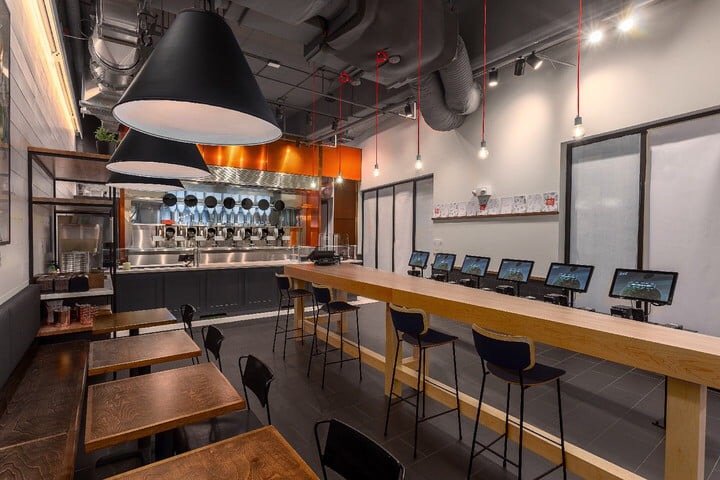
Instead of being seated by a host/hostess and ordering from a menu while at your table, a guide shows you to a touchscreen kiosk to place your order, which is then sent to the kitchen where you can see your food being prepared by the robots. It’s a human, though, who adds garnishes.
The recipes were created by Sam Benson of Café Boulud, and the robots at Spyce follow them to the note. Michelin-starred chef Daniel Boulud is on the advisory board.
“Running a restaurant is quite difficult,” Knight admitted. “It’s an industry of low margins, with high turnover rates, and little room for error. While I can’t speak to the industry as a whole, our technology has allowed us to deliver incredible meals for $7.50 and serve them consistently. We’re excited to be part of the industry and grow with it.”
Is This the Future?
Is this the future of restaurants? While it’s hard to deny the attractiveness of not having any human error while dining, it does make you wonder if the experience would then become too “cold” because of that lack of human interaction.
If the point is just to have food prepared by a machine, why not dine at home? Why not heat up a frozen meal that’s been prepared by machines as well? Why would you even bother to leave your home?
Then again, we need to remember that this is a fast food restaurant. So perhaps it helps on that level because there are fewer expectations with a fast food restaurant.
Is this an eating experience that would be attractive to you? Would you want to eat food prepared by robots? Or would you rather stick to human-prepared food, even if it leaves room for mistakes?
Let us know your thoughts and concerns about Spyce restaurant in the comments section below.
Image Credit: Spyce via Digital Trends