


With the “death” of MP3 greatly exaggerated, many folks have been wondering what the apparently superior format, AAC, is all about. But AAC isn’t the only format out there; there are plenty of other audio compression formats that are widely available.
Is MP3 Dead?
MP3 is the most popular audio format in the world. It’s hard to nail down exact statistics, but there’s a good chance that more devices support MP3 than any other audio format. The standard is far from dead. Rather, the patent on the technology has recently expired. Fraunhofer Institute for Integrated Circuits, the firm that managed licensing the patent for MP3, recently announced it would discontinue its patent licensing program and recommended users move to AAC. Some outlets took that to mean the MP3 was “dead.” In fact, the opposite is true: the MP3 format is now freely available to all.
How Does MP3 Work?
MP3, or MPEG-2 Audio Layer III, is a compression standard for encoding digital audio. It uses lossy data compression techniques that discard non-essential data to shrink the size of an audio file. When compared to audio files taken from a CD, an MP3 can shrink file sizes by as much as 95%, which is important for both bandwidth cost and storage considerations. The standard focuses on removing audio that’s outside the range of human hearing and implements principles of human sound perception, or “psychoacoustics,” to identify and discard sounds that the human ear won’t miss.
What About AAC?

AAC stands for Advanced Audio Coding. It’s a proprietary audio compression scheme with a lot in common with MP3. In fact, it was specifically designed to be the successor to the MP3 format, offering better sound quality than MP3 at the same bit rate. This means that AAC results in smaller file sizes while maintaining the same audio quality. It uses the same principles as MP3 for compression, discarding inaudible sounds and eliminating audio based on the psychoacoustic model.
Today, AACs are found as the audio component of the popular MPEG-4 video container. It’s also the default audio format for services like YouTube and widely supported by Apple and Sony. In contrast to MP3, however, the format is under patent and must be licensed to use legally.
How Do Lossless and Uncompressed Formats Fit In?
MP3 and AAC are both lossy formats, throwing away non-essential data to help reduce file size. Not all formats follow this principle, however. Lossless formats like FLAC or Windows Media Audio (WMA) compress audio using fully-reversible compression techniques shared with the ZIP algorithm. This shrinks file size while maintaining maximum quality. However, these formats are not as widely supported as lossy formats.
Audio doesn’t have to be compressed, however. Uncompressed formats like WAV and AIFF use pulse code modulation (PCM) to store data without alteration. Files encoded this way are larger but offer perfect reproduction and the greatest flexibility.
Are There Other Lossy Formats?
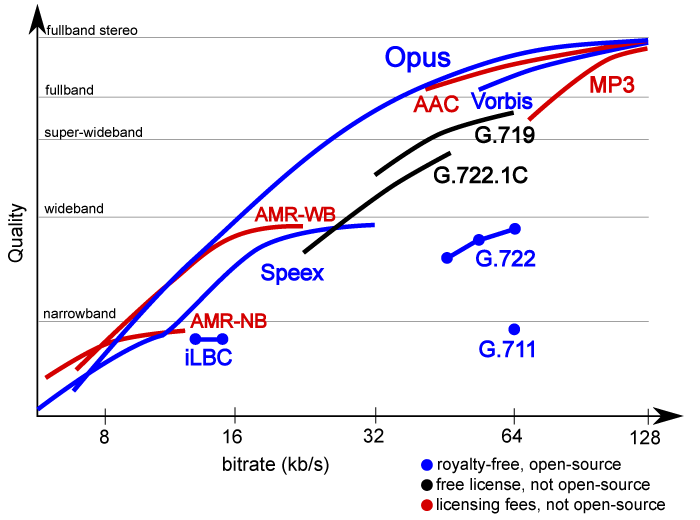
A wide variety of different lossy formats exist, with varying degrees of popularity. Open-source formats like “Opus” use specialized techniques to offer superior quality when compared to AAC, but support is comparatively limited. Televisions and DVD players frequently use the Dolby AC-3 format for their audio. A wide variety of highly-compressed telephony formats like BroadVoice exist to support digital phone calls and voice-over-IP (VoIP) communications. A few dozen other formats exist to fullfill specific niche uses. But MP3 is more common than all these other formats combined.
Conclusion
AAC offers a better quality-to-compression ratio than MP3, but a lack of ubiquitous support has held it back. And now that MP3 is free for public use, it’s likely to maintain its position as the dominant lossy audio format in the years to come.
Image credit: Opus quality comparison colorblind compatible