
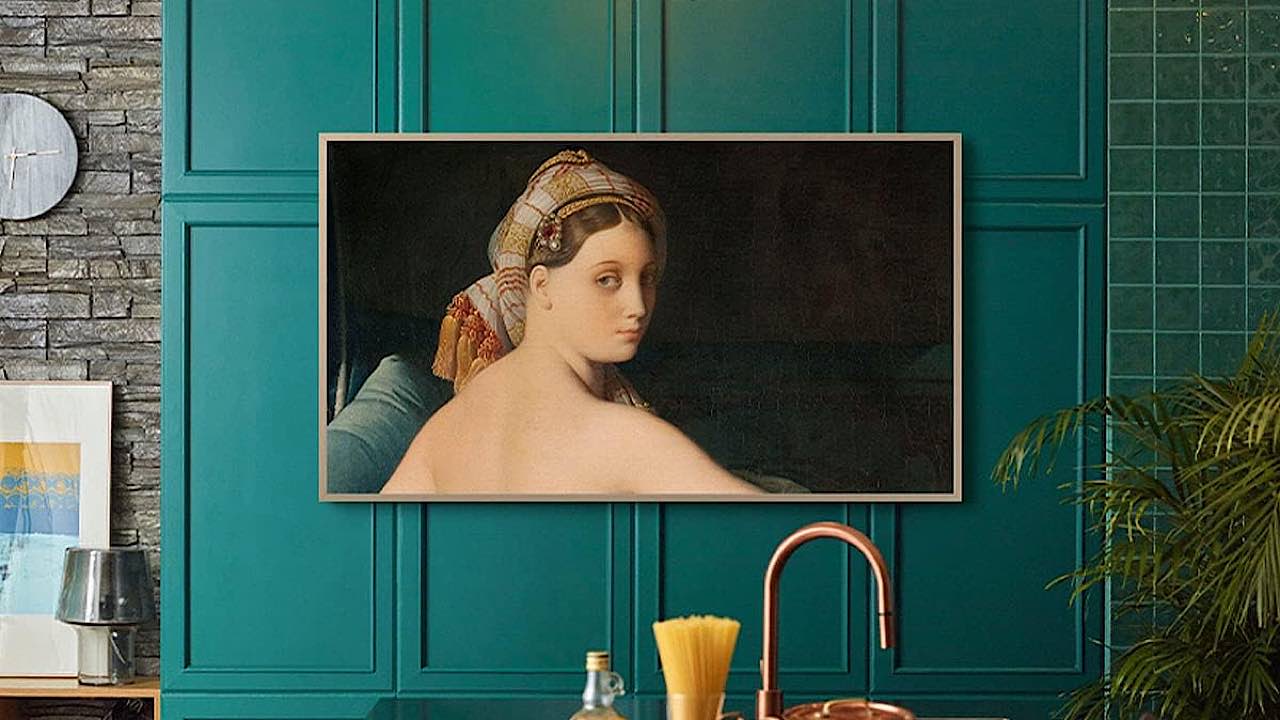
SAMSUNG The Frame Smart TV Looks Like Art

We may earn a commission from links on this page.
Deal pricing and availability subject to change after time of publication.
Samsung The Frame Featured

While at one point we hid our television sets away in cabinets, or even in separate rooms, with smart TVs, they’ve become central in our lives. If you want to keep your television central, but still want to “hide it way,” get a SAMSUNG The Frame and save up to 40%.

The QLED 4K TV has a billion shades of color at 100 percent color volume. It utilizes Quantum Dot technology to create a gorgeous picture with vivid colors that retain the bold details, even with a bright screen. Anti-reflection and the matte display film limit light distraction by reducing the glare. The content you’re watching will look just as good in the morning as it does at night.

Samsung Looks Like a Picture Frame

Quantum HDR allows you to move past HDTV, with an expanded range of color and contrast. The spectrum deepens blacks and brightens whites, allowing you to see Hollywood blockbusters the way they were meant to be seen.

Customize the bezel on The Frame from SAMSUNG by choosing the bezel type and color so that it fits in with your home décor. All you have to do is snap on your chosen magnetic bezel, which allows you to change it when you change your décor.

When you’re not watching TV, switch The Frame to Art Mode, allowing you to showcase your art collection via a built-in motor sensor. Alternatively, subscribe to SAMSUNG’s Art Store for access to more than 1,400 new and classic pieces of art. The included slim-fit wall mount aids the look by keeping The Frame flush against the wall. You’ll have only the One Invisible Connection cable that feeds into the Slim One Connect box.

Save from 11% to 40%, and pay $887.99 to $2,597.99 on 43”, 55”, 75”, and 85” sets. If you’re looking for 50” or 65”, look to pay full price.

SAMSUNG The Frame

Make Tech Easier may earn commission on products purchased through our links, which supports the work we do for our readers.

Subscribe to our newsletter!

Our latest tutorials delivered straight to your inbox

Laura Tucker Avatar

Read next

When survivors near Lake Nyos woke on the morning of 22 August 1986, the cattle were dead in the fields, the birds had fallen out of the trees, and 1,746 of their neighbours were lying where they had stood the night before, with no fire, no flood, and no wound to explain it.
In 1959, a Soviet research team in Novosibirsk began breeding silver foxes for nothing but tameness, and within forty generations the animals had floppy ears, curled tails, piebald coats, and a bark, traits no one had selected for but which appeared on their own once fear was removed.
Psychology suggests people who browse social media but never post or comment aren’t passive — they’ve simply opted out of the performance while retaining access to the information, which is a sign of quiet self-awareness
Toy Story 2 was nearly erased from existence when someone at Pixar accidentally ran a delete command on the film’s master files, wiping out roughly 90 percent of the project — and the only reason the production survived was that Galyn Susman, a technical director on maternity leave, had a working copy on a computer at her house.
A Japanese man named Jiroemon Kimura, who lived to 116, was born in 1897 when Queen Victoria still ruled and died in 2013, meaning a single human life personally overlapped with the invention of the airplane, the atomic bomb, the internet, and Instagram
The Hollywood sign originally read HOLLYWOODLAND when it was built in 1923 as a real estate advertisement for a housing development, and it was only meant to stand for 18 months, but nobody ever got around to taking it down and the city eventually adopted it as a landmark
In 1859 a storm on the Sun struck the Earth so hard that telegraph wires threw sparks and operators were shocked at their desks, and scientists warn the same event today would knock out power grids across entire continents.
Almost all of the world’s internet traffic does not travel by satellite but through fibre-optic cables lying on the ocean floor, a hidden web of wires crossing the deepest parts of the sea to connect the continents.