

Bring Your Old Photos to Life With the Kodak Digital Film Scanner

We may earn a commission from links on this page.
Deal pricing and availability subject to change after time of publication.
Kodac Digital Scanner

We all have old photo memories tucked away in boxes, often forgotten and gathering dust. These moments deserve to be preserved, and the Kodak Digital Film Scanner is the perfect tool to bring them back to life, now available on Amazon for just $180.

This 22MP digital scanner comes with a 5” LCD display with gallery mode. The large, crystal-clear screen offers a wide viewing angle. You can instantly preview and edit your photos right on the device. The gallery mode is also perfect for sharing your newly digitized memories with friends and family. You can even display them as a digital picture frame for that touch of nostalgia in your space.
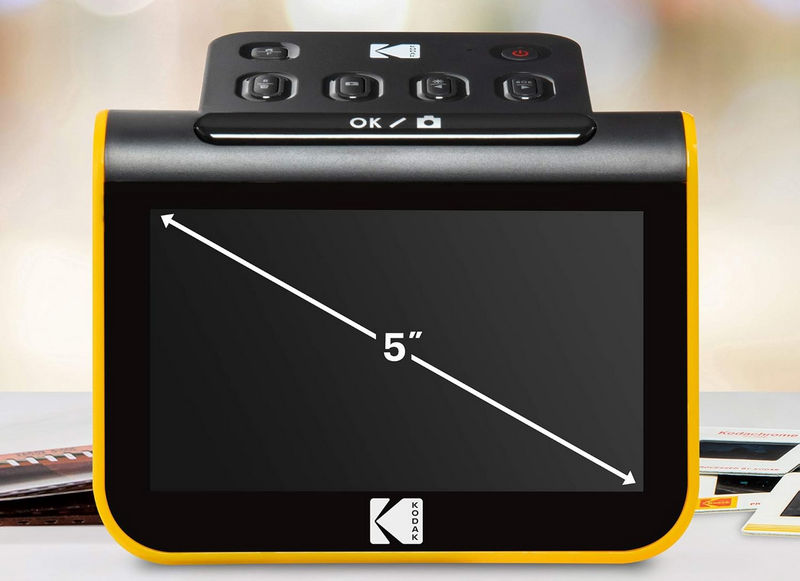
Screen Of Kodac Digital Scanner

Kodak has designed this tool with convenience in mind. Its quick-feeding tray technology and easy-load film inserts allow for continuous scanning. You can swiftly move through your collection without hassle. The scanner supports 135, 110, and 126mm film formats, as well as 50mm slides. The package also includes a 50mm slide holder, adapters for different films, a cleaning brush, and both USB and HDMI cables – everything you need to start preserving your memories.

Editing your photos is incredibly straightforward, thanks to the scanner’s advanced capture software. A simple OK/Scan button lets you enhance, resize, and convert your images with ease. You can adjust color and brightness, and even assign a date and time to your digital files in no time. Even if you don’t have any prior editing experience, you shouldn’t have any problems.

Kodac Scanner Buttons

The Kodak scanner supports SD and SDHC cards up to 32GB (not included), so you can store a significant number of images. Plus, it connects effortlessly to any Type-C USB-enabled computer, making the process of transferring your digital files simple and straightforward.

Get the multifunctional and easy-to-use Kodak Digital Film Scanner on Amazon for $180.

Kodak Digital Film Scanner

Make Tech Easier may earn commission on products purchased through our links, which supports the work we do for our readers.

Subscribe to our newsletter!

Our latest tutorials delivered straight to your inbox

Zainab Falak Avatar

Read next

In 2016, archaeologists dated two rings of snapped stalagmites in France’s Bruniquel Cave to 176,500 years ago, evidence that Neanderthals had walked 336 metres into darkness with fire and built architecture deep underground long before modern humans reached Europe
Otto von Bismarck was 74 when Germany adopted the world’s first national old-age social insurance program in 1889, setting the pension age at 70 after years of fighting socialists with bans, laws, and a promise few workers would live long enough to use
When cosmonaut Valeri Polyakov stepped out of his Soyuz capsule in March 1995 after 437 consecutive days aboard Mir, doctors recorded him at several centimetres above his pre-flight height, and his spine had become so unaccustomed to gravity that the recovery team carried him to a chair rather than risk the compression of letting him walk.
When Harvard astronomer Cecilia Payne submitted her 1925 doctoral thesis arguing that the Sun was made almost entirely of hydrogen, the field’s senior figure Henry Norris Russell talked her into adding a line calling the result ‘almost certainly not real,’ and then published the same conclusion himself four years later to widespread acclaim.
When Edme Mariotte stared at marks on a wall in the 1660s, one mark vanished inside a six-degree hole where the optic nerve leaves the eye and the brain has been filling in wallpaper, sky, and faces ever since
When seismic waves from the Chicxulub impact reached what is now North Dakota roughly ten minutes after the asteroid struck, they appear to have triggered a ten-metre standing wave in an inland river that flung fish onto the bank and buried them under glass beads still falling from the sky.
When survivors near Lake Nyos woke on the morning of 22 August 1986, the cattle were dead in the fields, the birds had fallen out of the trees, and 1,746 of their neighbours were lying where they had stood the night before, with no fire, no flood, and no wound to explain it.
In 1959, a Soviet research team in Novosibirsk began breeding silver foxes for nothing but tameness, and within forty generations the animals had floppy ears, curled tails, piebald coats, and a bark, traits no one had selected for but which appeared on their own once fear was removed.