

Maximize Desk Space with GEEKOM XT12 Pro Mini PC

We may earn a commission from links on this page.
Deal pricing and availability subject to change after time of publication.
Screenshot

You don’t have to have a large, behemoth PC to get great graphics, dual-channel RAM, an SSD up to 2TB, and Wi-Fi 6E. Get the GEEKOM XT12 Pro 12th Gen for $150 off through June 19.

This mini PC is powered by the Intel Core i9-12900H processor. It features 14 CPU cores, 20 threads, and 24MB Intel Smart Cache. It’s the ultimate machine for creative types. Get inspired on the Web, edit 4K videos, and work on 3D modeling, among many other creative pursuits. From start to finish, this PC and the preinstalled Windows 11 Pro will see you through.

Store all those projects, too, on the dual-channel DDR4, which holds up to 64GB, along with the M.2 2280 PCIe Gen 4*4 SATA slot (up to 1TB). It’s just as fast as it is massive.
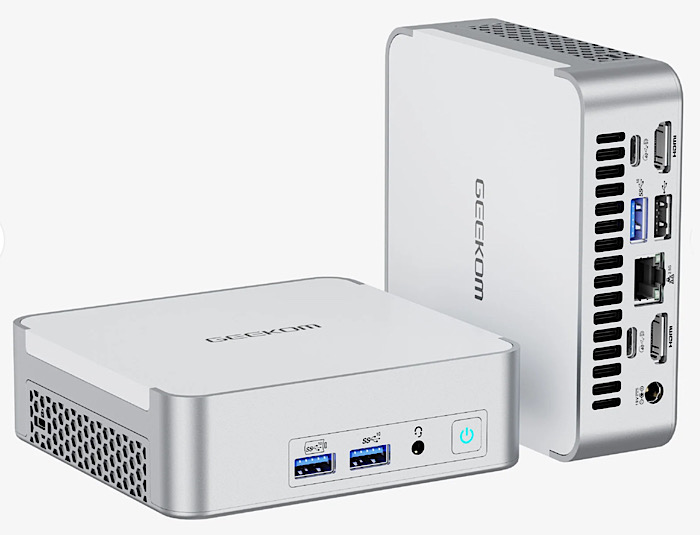
Geekom Xt12 Pro Mini Pc Ports

Connect to the GEEKOM XT12 Pro 12th Gen via Wi-FI 6E or 2.5G Ethernet, and utilize various ports, including two USB 3.2 Gen 2, two USB 4 Gen 3 (supporting power delivery), Thunderbolt 4, and two HDMI 2.0. These support multiple screens, even four 4K displays. Also connect an external GPU to get the most out of your gaming.

Maximize your desktop space with this compact, stylish design. All the power is housed in a uni-body aluminum chassis, weighing just over 1 pound and measuring approximately 4.6” x 4.4” x 1.5”. It’s easily hidden behind the monitor with the included VESA mount. Inside are copper pipes, a silent fan, and the latest version of the IceBlast 1.0 cooling system, keeping it cool, stable, and quiet.

GEEKOM Mini PC is having a 21st birthday party, but you get the gifts! Get up to 50% off various products in this sale through June 22, with prices that beat Prime Day!

If you’re in the U.S., get the GEEKOM XT12 Pro 12th Gen for just $549 after using the $150 off coupon code MAKEXT12 through June 19.

If you’re in the U.K., get the GEEKOM XT12 Pro 12th Gen for just £549 after using the $150 off coupon code MAKEXT12 through June 19.

Make Tech Easier may earn commission on products purchased through our links, which supports the work we do for our readers.

Subscribe to our newsletter!

Our latest tutorials delivered straight to your inbox

Laura Tucker Avatar

Read next

Psychology suggests people who browse social media but never post or comment aren’t passive — they’ve simply opted out of the performance while retaining access to the information, which is a sign of quiet self-awareness
Toy Story 2 was nearly erased from existence when someone at Pixar accidentally ran a delete command on the film’s master files, wiping out roughly 90 percent of the project — and the only reason the production survived was that Galyn Susman, a technical director on maternity leave, had a working copy on a computer at her house.
A Japanese man named Jiroemon Kimura, who lived to 116, was born in 1897 when Queen Victoria still ruled and died in 2013, meaning a single human life personally overlapped with the invention of the airplane, the atomic bomb, the internet, and Instagram
The Hollywood sign originally read HOLLYWOODLAND when it was built in 1923 as a real estate advertisement for a housing development, and it was only meant to stand for 18 months, but nobody ever got around to taking it down and the city eventually adopted it as a landmark
In 1859 a storm on the Sun struck the Earth so hard that telegraph wires threw sparks and operators were shocked at their desks, and scientists warn the same event today would knock out power grids across entire continents.
Almost all of the world’s internet traffic does not travel by satellite but through fibre-optic cables lying on the ocean floor, a hidden web of wires crossing the deepest parts of the sea to connect the continents.
A four-month-old Chinese startup just launched a $118 AI collar that claims to translate dog and cat vocalizations into human sentences with 95% accuracy — an extraordinary consumer device that has secured $1 million in funding despite zero independent scientific proof that it actually works
NASA still maintains some of the Voyager spacecraft code in a 1970s-era programming language that almost nobody on Earth fully understands anymore, and the handful of engineers who do are now in their 80s.