
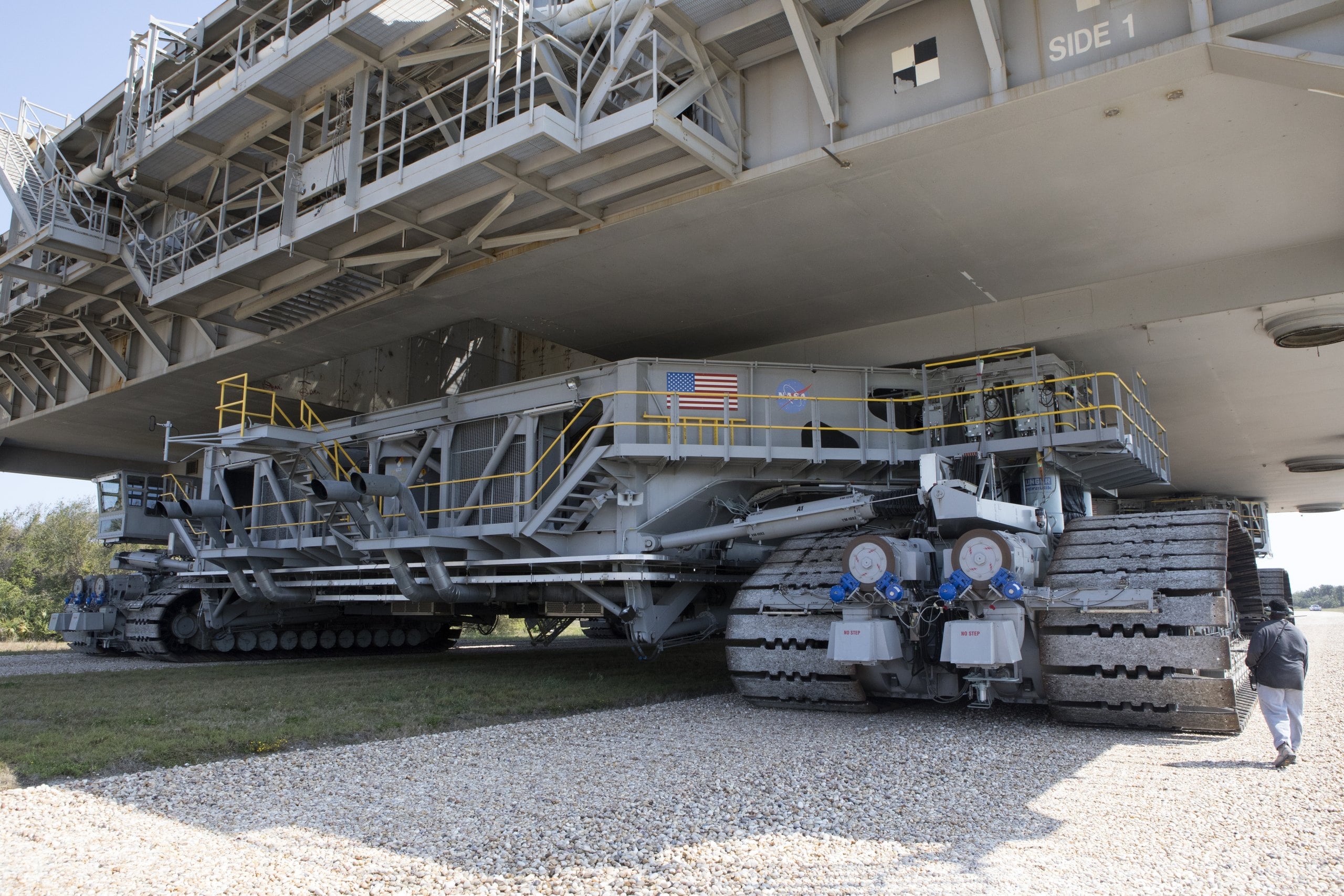


The crawlers NASA uses to carry rockets from the Vehicle Assembly Building to the launch pad were built in 1965 to move the Saturn V, and NASA lists their weight at approximately 6.6 million pounds. The agency’s crawlers page compares that to about 15 Statues of Liberty or 1,000 pickup trucks.
NASA said in a blog post on 13 October 2026 that teams at Kennedy Space Center in Florida had completed integrating the final solid rocket booster segments for Artemis III, and that the rocket will roll from the Vehicle Assembly Building to Launch Pad 39B for a tanking test in the coming months.
The blog does not name the vehicle for that move. The crawlers page describes crawler-transporter 2, or CT-2, as “integral to the Artemis missions.”
NASA said in a blog post on 16 January 2026 that crawler-transporter 2 would carry the 11-million-pound Artemis II stack to Launch Pad 39B.
A 1965 machine
NASA built two crawler-transporters to move the Saturn V from the Vehicle Assembly Building to Launch Complex 39. Fabrication began in Ohio in March 1963, and a crawler moved under its own power for the first time on 23 January 1965. The first Saturn V went to the pad on 26 August 1967 for the unmanned Apollo 4 mission.
Each crawler is the size of a baseball infield, according to the page.
Locomotive engines and large electrical power generator engines drive the machines. Height varies from approximately 20 feet to 26 feet depending on the position of the jacking, equalization and leveling cylinders. Load capacity is 18 million pounds, which NASA compares to more than 20 fully loaded 777 airplanes.
After the Moon landing and Skylab programs ended, the crawlers took space shuttles to their launch pads for 30 years. On 1 May 1979 a crawler carried the shuttle Enterprise, with an external tank and two inert solid rocket boosters, to Launch Pad A for a fit check. The shuttle fleet retired in 2011.
On 16 November 2011 a crawler moved the Space Launch System mobile launcher from the park site beside the VAB to Launch Pad 39B.
The page names CT-2 for four later entries. It carried the mobile launcher along the crawlerway to Pad 39B on 28 June 2019 for verification and validation testing, then carried the SLS with Orion on top of the mobile launcher to the pad between 17 March and 26 April 2022 for the Artemis I wet dress rehearsal tests.
Between 3 November and 9 December 2022 CT-2 carried the rocket out again for the Artemis I launch on 16 November, then brought the mobile launcher back to the VAB and later to a parking location at Kennedy for modifications ahead of Artemis II.
On 29 March 2023 Guinness World Records presented a certificate designating CT-2 “the heaviest self-powered vehicle.”
The short stack
The booster segments are for what NASA calls the “short stack” configuration, the rocket NASA says it will roll from the VAB to Launch Pad 39B for the tanking test.
Teams also installed all four RS-25 engines on the SLS core stage.
Next they will fit the systems tunnel that runs the length of the stage and routes pyrotechnic cabling, and in the coming weeks the stage will be joined to the boosters.
NASA’s timing for the move to Pad 39B is “in the coming months.”
At the pad the Artemis launch team will practice procedures and timelines for loading propellant. The Artemis III crew, NASA astronauts Randy Bresnick, Frank Rubio and Andre Douglas and ESA astronaut Luca Parmitano, will also conduct a launch day rehearsal and an emergency exit walkdown, including suiting up, driving to the pad and ascending the mobile launcher.
The crawlers have carried rockets and spacecraft to the pad at Kennedy for more than 50 years.
Sources:
- NASA, The Crawlers: https://www.nasa.gov/humans-in-space/exploration-ground-systems/the-crawlers/
- NASA Blogs, NASA Completes Artemis III Booster Stacking, Shares Status Update: https://www.nasa.gov/blogs/missions/2026/10/13/nasa-completes-artemis-iii-booster-stacking-shares-status-update/
- NASA Blogs, Artemis II Moon Rocket Ready for Big Move: https://www.nasa.gov/blogs/missions/2026/01/16/artemis-ii-moon-rocket-ready-for-big-move/