


Apple is following up its Academy Awards success by foraying in a new direction: airing live sports. Apple will air “Friday Night Baseball” weekly on the subscription service Apple TV+, yet will not require a subscription to view the games.
Also read: 22 Android TV Apps to Supercharge Your Smart TV
Friday Night Baseball
Apple’s first two Friday Night Baseball games will air on April 8, 2022. Joining the programming lineup will be three more shows: “Countdown to First Pitch,” “MLB Daily Recap,” and “MLB Big Inning.”
All of the baseball content will air for free on the subscription Apple TV+ service – at least initially. It’s available to anyone with access to the Internet. It is, of course, offered on the Apple TV app on iPhones, iPads, Macs, and Apple TVs, and is also available on tv.apple.com.
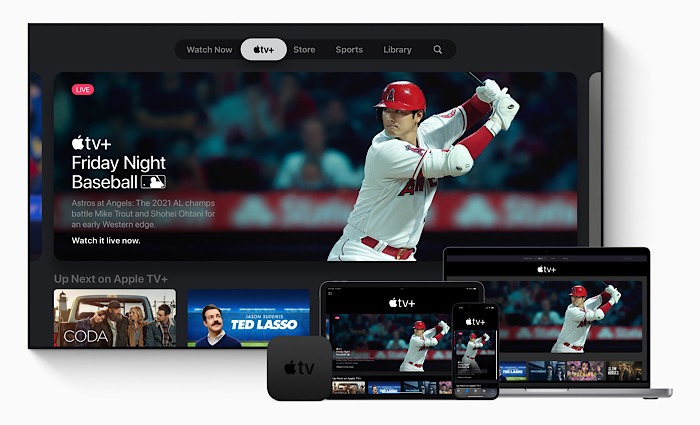
Smart TVs, gaming consoles, and cable set-top boxes will be offering it on Apple TV+ as well. Internationally, it will be offered in the U.S., Canada, Australia, Brazil, Japan, Mexico, Puerto Rico, South Korea, and the U.K.
Not surprisingly, Apple will work in several product endorsements. On-screen graphics for batter walk-ups will feature Apple Music content, and baseball trivia will be provided by Siri. The batter walk-up song playlists will be available on Apple Music too.
Let’s Play Ball!
The very first Friday Night baseball game on Apple TV+ will be the New York Mets vs. the Washington Nationals at 7 PM ET. Melanie Newman will be on play-by-play, Chris Young and Hannah Keyser on analysis, and Brooke Fletcher reporting.
The second game at 9:30 PM ET will feature the Houston Astros vs. the Los Angeles Angels with Stephen Nelson on play-by-play, Hunter Pence and Katie Nolan on analysis, and Heidi Watney reporting.

It’s refreshing to see so many women on the broadcast team. In fact, the entertainment overall will be a modern, refreshing take on baseball reporting. Apple is hoping it will “appeal to new viewers and veteran fans alike.”
The tech company will be using “state-of-the-art cameras, including high-speed Phantoms, the high-resolution megalodon, and more throughout the season to present vivid, live-action shots, and other immersive sound in 5:1 with spatial audio enabled.”
On-screen graphics will include “probabilities-based forecasts of different outcomes,” as well as highlights and glances at other action around the league. Former MLB umpire Brian Gorman will provide rules analysis and interpretation.

The action doesn’t stop there. U.S. and Canadian viewers will get 24/7 programming with game replays, news, analysis, highlights, and classic games. MLB Daily Recap will air every morning and MLB Big Inning every evening. After the live broadcasts each week, viewers will have on-demand access to full games and condensed games.
If you go on to try the Apple TV+ subscription service and decide it’s just not for you, read on to learn how to cancel it.