

Apple Credit has been around a while, with it expanding in the past few years to also include the AppleCard, created with Goldman Sachs. Of course, it can help customers buy Apple products. While it would seem on the outside like it’s all working well, some people with the Apple Card aren’t so happy. The Consumer Financial Protection Bureau (CFPB) has stepped in and ordered both Apple and Goldman Sachs to pay nearly $90 million in penalties altogether.
Consumer Dispute with Apple and Goldman Sachs
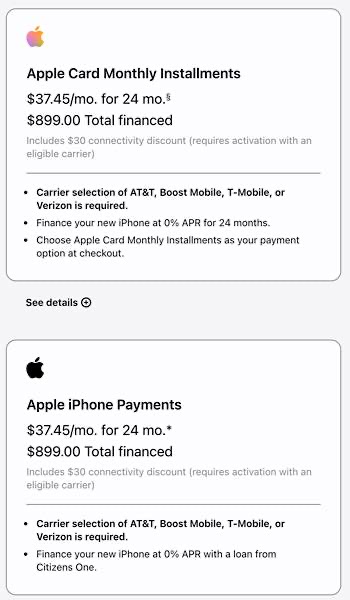
First and foremost, consumers felt misled about interest-free options when buying Apple devices with the Apple Card. There was indeed interest, and buying the Apple products with Apple Card was not interest-free financing.
I have to say that I can see why it may seem like an attractive offer and how that could be confusing. I recently financed an +iPhone 16. There were several options. Financing through Apple (through a separate bank) seemed to be the same price as financing it with the Apple Card. I don’t have the Card, so I financed it through Apple, but I can see why people could get confused.
The CFPB is also looking into how Goldman Sachs handled fraud and refunds in relation to the Apple Card. It all resulted in incorrect credit reports for customers and charge disputes that went unresolved.
The CFPB director, Rohit Chopra, believes Goldman Sachs didn’t properly handle customer disputes when they came up. He also said they didn’t follow federal requirements to look into and resolve the issues in a timely manner. The Apple Card wasn’t completely ready, the board at Goldman Sachs was told, and still decided to move forward.
Good to know: If you want to steer clear of credit cards, try one of these virtual credit cards or a single-use credit card number.
Apple and Goldman Sachs Must Pay
The CFPB has now ordered Apple and Goldman Sachs to pay penalties for the way they handled the Apple Card and the business. Apple was fined $25 million, and Goldman Sachs was fined $45 million. The bank must also refund $19.8 million to customers.
That’s a lot of money, but perhaps the most pertinent part of the punishment is that Goldman Sachs is not allowed to offer any new credit cards other than the Apple Card. If they intend to, they most provide a plan to federal regulators to prove they will follow the law this time.
A Goldman Sachs spokesman, Nick Carcaterra, said that Apple Card was “one of the most consumer-friendly credit cards.” He added that they worked to address the challenges with it and that the issues have been addressed with customers.
It’s hard to say they’re the most consumer friendly when they’ve been fined for the way they handled their customer relations.
An Apple spokeswoman said the company worked with Goldman Sachs to address the issues and help affected customers years ago. The company disagrees with the CFPB about their conduct, but they have reached an agreement.
Goldman Sachs is poised to leave its cooperation with Apple’s credit cards, and it also sold its General Motors credit cards to Barclays.
Nothing has been said about how any of this will affect the Apple Card, but if I was thinking of getting one, I definitely wouldn’t be now. If you’re thinking of getting a new credit card, check your credit score for free on one of these websites.
Image credit: Apple. Screenshot by Laura Tucker.