

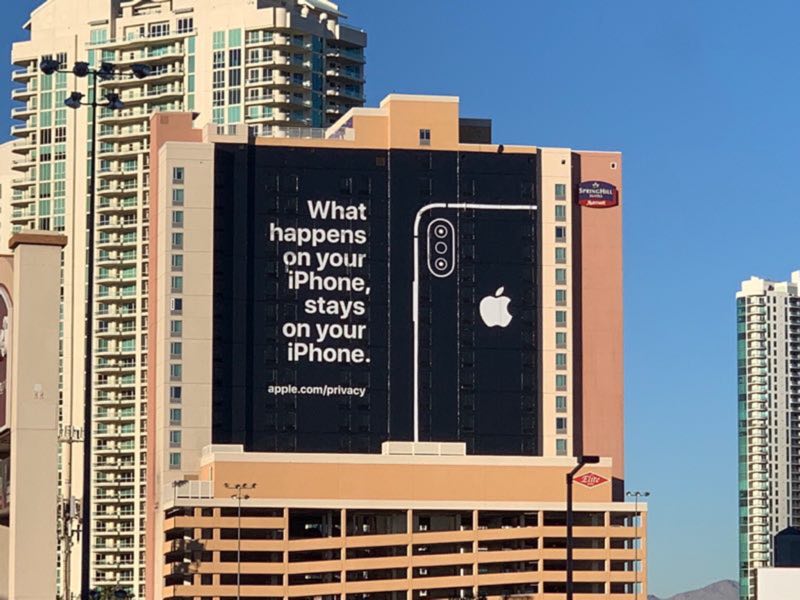
Everyone has heard the Las Vegas, Nevada, advertising slogan, “What happens in Vegas, stays in Vegas.” And if you’ve visited this wild town, you understand. Curiously, Apple erected a billboard in Las Vegas touting, “What happens on your iPhone, stays on your iPhone.”
Hinting at Privacy
Near the very part of Las Vegas where the Consumer Electronics Show will be taking place starting on January 8, the Las Vegas Convention Center, Apple hung the huge sign reading, “What happens on your iPhone, stays on your iPhone.”
It is a simple black-and-white image with an outline of the back of an iPhone. In smaller print below the slogan it says “apple.com/privacy.”
Chris Velazco of Engadget published a photo of the billboard to Twitter and captioned it, “Apple never shows up at CES, so I can’t say I saw this coming.”
Following the link mentioned on the billboard takes you to a page on their site where they discuss their privacy protocol, stating, “At Apple, we believe privacy is a fundamental human right.”
Despite the slogan, this isn’t just something they are thinking of in relation to iPhones.
“Every Apple product is designed from the ground up to protect that information. And to empower you to choose what you share and with whom,” adds Apple.
It then goes on to describe Apple’s privacy practices, explaining you can secure your device with a six-digit passcode or use Touch ID or Face ID. You can even add more security by creating an alphanumeric passcode.
It’s basically a really hard sell on their privacy practices. “Whether you’re taking a photo, asking Siri a question, or getting directions, you can do it knowing that Apple doesn’t gather your personal information to sell to advertisers or other organizations.”
The page goes on and on through several more areas of privacy, ensuring every time that your information is safe.
Maybe this is how they plan to regain their losses. It was widely published last week that Apple didn’t meet their projected sales. Maybe they are touting their privacy policy to bring users back into the fold, though it’s widely believed that much of the loss came from sales in China.
Furthermore
However, Apple doesn’t showcase its products at CES. Instead, they do that at the Worldwide Developers Conference (WWDC) that they usually hold in July every year. You have to see this as smart marketing, erecting a billboard speaking to tech enthusiasts when you’re not even planning on having a presence at the CES.
Does this billboard statement create a larger interest in you with regards to Apple’s products? Does privacy mean that much to you? Should they just go ahead and join CES in the first place? What do you think about Apple’s privacy billboard in Las Vegas? Let us know your thoughts in the comments section below.
Image Credit: Twitter and Public domain