


Amazon already has a strong foothold in the smart home space, with several Echo speakers, Fire TVs, Ring doorbells, and more, not to mention the hundreds of devices that incorporate the Alexa voice assistant. This week Amazon improved its lineup by adding the Halo Rise, an alarm clock with sleep tracking capabilities, and other new devices.
Also read: 7 Easy Fixes for Common Amazon Echo Dot Problems
Amazon Introduces the Halo Rise
Sleep tracking is suddenly very important to our well-being. Twenty years ago, many of us wouldn’t have thought of monitoring our sleep unless we were having sleep difficulties, but once we gained that ability, we all have to have it.
Until now, we’ve had sleep tracking mostly in smartwatches, fitness bands, and smartphones, but Amazon introduced the Halo Rise, an alarm clock with sleep tracking capabilities.
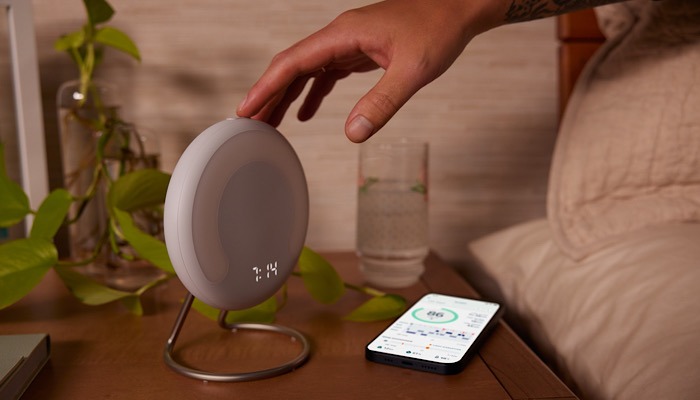
Amazon described the Halo Rise in its press release as “a new multi-purpose bedside tracker dedicated to helping improve your sleep,” adding that it “uses built-in sensor technology, quietly working in the background to provide highly accurate insights and personalized sleep analysis.”
The Halo Rise is designed to manage your sleep patterns in the background. Unlike fitness bands and smartwatches, it’s contactless and uses low-energy sensor technology and machine learning to track your respiration and movement to log your sleep patterns.
Upon waking up, you’ll receive a summary of your sleep with a sleep score and a graph showing light and deep sleep and REM. Notably, this doesn’t seem much different than what you receive from a smartphone, smartwatch, or fitness band. But the Rise integrates with the Halo app that works alongside the Halo fitness band.

Also when you wake up, a light on the Halo Rise will simulate a gradual sunrise to wake you up gently. This is reminiscent of some smart alarm clocks that are naturally a fraction of the price. Alexa will be there to help you wake up as well, offering music, news, weather, and other ways to customize a morning routine.
Amazon will be offering the Halo Rise for $139.99 later in 2022. It includes a six-month Halo membership.
Amazon Smart Home Device Improvements
Along with the Halo Rise, Amazon also offered additions to the Echo speaker lineup, Blink security cameras lineup, and the Fire TV Omni series.
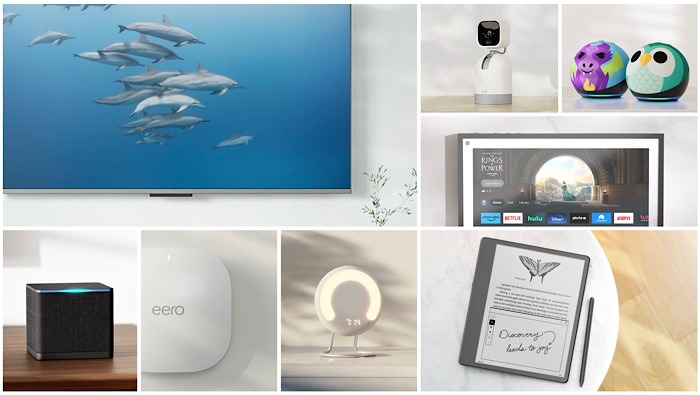
The Echo Dot and Echo Dot With Clock have new sensors that allow you to interact with Alexa more contextually, to go beyond simple requests. An accelerometer allows you to tap the speakers to pause and play, turn off a timer, etc. eero Built-in is included as well, allowing the speakers to operate as eero mesh Wi-Fi extenders.
Echo Dot Kids has two new Owl and Dragon designs and accompanying Alexa voices, and Echo Studio now has spatial audio. The new and improved devices will be available next month.
Added to the Blink lineup are the Blink Wired Floodlight Camera and the Blink Mini Pan Tilt. The wired floodlight camera adds 2600 lumens of LED lighting, preferred motion and detection zones, and new person detection, allowing you to not be bothered by areas out of your concern and only be notified if a person is in the zone.
The Blink Mini Pan Tilt is a motorized tilt add-on for your existing Blink Mini with 360 degrees of coverage. It’s available now for preoder, while you’ll see the floodlight cam in the coming months.
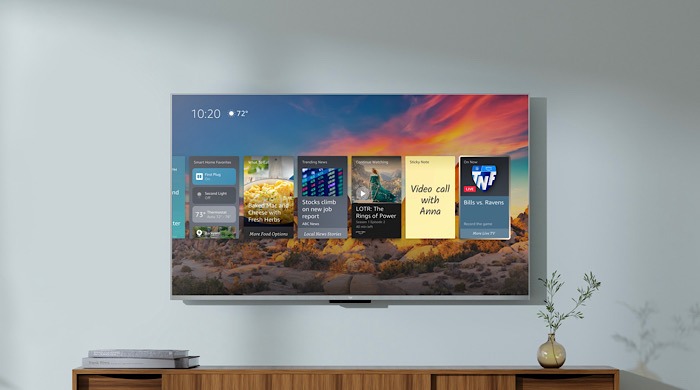
The Fire TV Omni Series added the Fire TV Omni QLED Series to the lineup. It’s the first ever to include the new Fire TV Ambient Experience. It combines everything you know about the Omni Series with the new ambient features, making the Omni an always-smart device when it’s not being used to stream entertainment. The series is available for preorder today.
Also announced today were a new Fire TV Cube (3rd Gen) and Alexa Voice Remote Pro with programmable buttons and a Remote Finder. If you’re interested in Apple products, find out about the iPhone 14 series, Apple Watch Ultra, and more that were released earlier this month.
Image credit: Amazon