


You may be thinking a new fitness band is the last thing the tech world needs right now, but Amazon just couldn’t stop themselves from entering into that space. Now available is the Amazon Halo Band that will measure not just your health, but your wellness, too.
What Is the Amazon Halo Band?
The device is the Amazon Halo Band, and Amazon Halo is the service that combines five AI-powered health and wellness features “that provide actionable insights into overall wellness.” The band uses multiple advanced sensors to deliver accurate information to Halo Insights.
Amazon doesn’t believe there has been a corresponding improvement between health and digital health services. This led them to use “Amazon’s deep expertise in artificial intelligence and machine learning to offer customers a new way to discover, adopt, and maintain personalized wellness habits,” according to Dr. Maulik Majmudar, Principal Medical Officer for Amazon Halo.
The company believes our health is more than just the number of steps we take each day and the number of hours we sleep. “Amazon Halo combines the latest medical science, highly accurate data via the Halo Band sensors, and cutting-edge artificial intelligence to offer a more comprehensive approach to improving your health and wellness.”
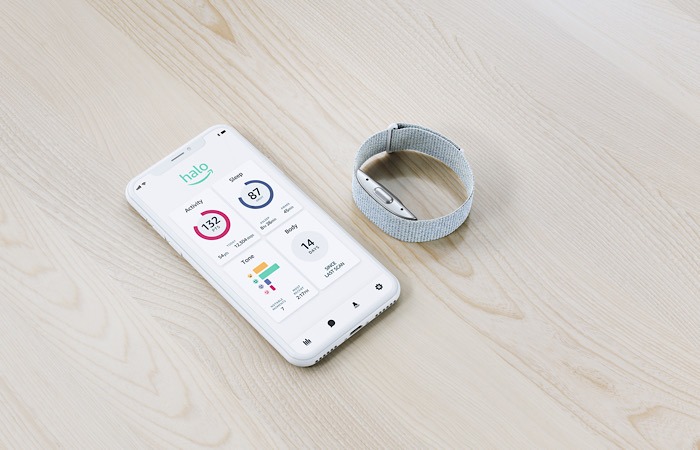
The Amazon Halo Band focuses only on health and wellness and not additional apps like fitness trackers and smartwatches. It includes an accelerometer, a temperature sensor, a heart rate monitor, two microphones, an LED indicator light, and a button for turning the mics on and off. It’s water-resistant for all-day wear, with the battery lasting up to seven days and fully charging in under 90 minutes.
Amazon Halo Features
The Amazon Halo service is a suite of five core features that allow users to examine their overall health and wellness. These core features include:
- Activity: points are awarded on the intensity and duration of movement instead of just the number of steps you take.
- Sleep: motion, heart rate, and temperature are used to measure the time asleep and awake, time spent in different phases of sleep, and skin temperature.
- Body: computer vision and machine learning measures body fat percentage and makes the important information accessible.
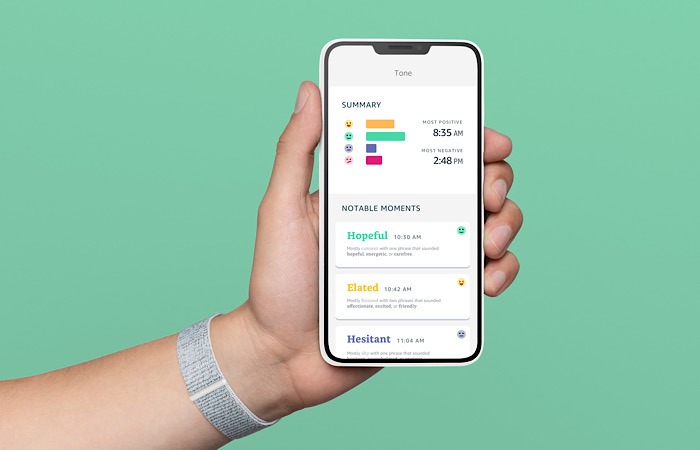
- Tone: machine learning is used to analyze energy and positivity in a customer’s voice to better understand how they sound to other people to improve communication and relationships.
- Labs: science-backed challenges, experiments, and workouts will allow users to discover what works well for them.
Amazon promises a secure service, noting that health data is encrypted while in transit and in the cloud. Users can download or delete their data at any time if they are concerned. Only they see their body scan images, as they are automatically deleted from the cloud.
Leading health and wellness companies are working along with Amazon Halo for more ways to enhance the health and wellness benefits. For instance, members of WW can link their accounts to Amazon Halo to share Activity information with the WW app.
Availability
Early access to Amazon Halo is available in the U.S. Through the early access period, Amazon Halo will be available for a price of $64.99, which includes six months of the Halo membership. After this period, the price will go up to $99.99. When the membership automatically renews after six months, it will be at a cost of $3.99 per month.
The Band is offered in three color combinations of band and sensor capsule. Additional bands are offered in more colors for an additional cost.
Image Credit: Amazon Halo