
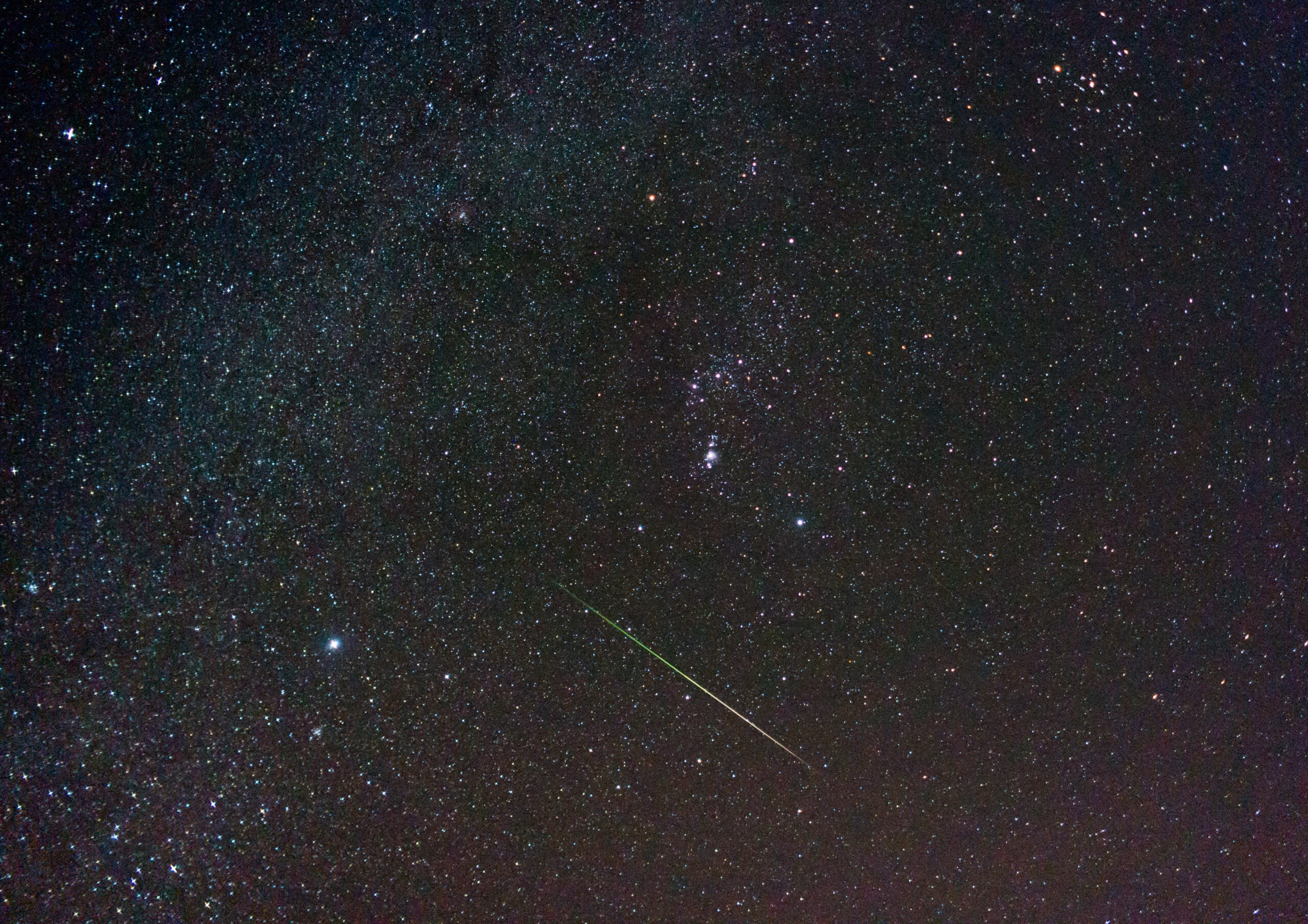


The Leonid meteor shower peaks overnight on 17 to 18 November. Under ideal dark skies the shower can produce around 15 meteors an hour, though most people will see fewer. Mars and Jupiter sit almost side by side in Leo, the constellation the meteors appear to come from.
The two facts are unrelated in space but convenient in practice. The planets are the brightest markers in that part of the sky, and the shower’s radiant lies in the same constellation.
The peak night, the real rate, and a cooperative Moon
The Leonids are active from 6 to 30 November, with the maximum falling this year on the night of 17–18 November. NASA’s What’s Up guide for November 2026, timeanddate, EarthSky and the International Meteor Organization all point to that night, although NASA’s standing Leonids page still lists a peak night of 16–17 November.
The same NASA guide also marks 17 November for a public Shine Bright event, the evening before Voyager 1 reaches one light-day from Earth.
Exact clock times vary by model. The IMO’s 2026 meteor shower calendar, edited by Jürgen Rendtel, places the regular nodal maximum at 23:45 UT on 17 November. The American Meteor Society, as cited by EarthSky, lists 0 UT on 18 November. Maslov, cited in the same IMO calendar, gives 16h UT on 17 November.
Those times matter less than they look. A maximum quoted in universal time can fall before the radiant has risen at a given longitude, so the useful window is local: midnight to dawn.
The headline rate needs the same care. The IMO lists a zenithal hourly rate of about 15, a figure that assumes a dark sky and a radiant overhead. In NASA’s What’s Up guide for November 2026, Raquel Villanueva said that under ideal conditions the shower “could produce around 15 meteors per hour, though most viewers will see fewer.”
Estimates below that exist. EarthSky‘s Deborah Byrd and Marcy Curran put the range at 10 to 15 under a dark, moonless sky. NASA’s general Leonids page gives an observed dark-sky rate of “fewer than 3 meteors per hour.”
Moonlight is not a problem this year. The Moon reaches first quarter on 17 November — at 11:48 UTC, according to EarthSky — and a first-quarter Moon sets around midnight, which is when the prime window opens.
How to watch between midnight and dawn
The radiant in Leo rises around midnight and climbs toward its highest point before dawn, so meteor counts tend to improve through the small hours. The shower is visible from both hemispheres.
NASA’s advice is simple: find a dark location, give the eyes about half an hour to adjust, and take in as much sky as possible. timeanddate says a bright phone screen interferes with that night vision. Fainter meteors are also easy to lose under light pollution, which is why astronomers have pushed back against proposals to put advertisements in orbit.
Staring directly at Leo is not the best approach. NASA’s Leonids page says it is “actually better to view the Leonids away from the radiant,” because meteors seen at an angle from it trace longer paths. Meteors can appear anywhere in the sky.
NASA’s Leonids page advises lying back, facing the sky, and taking in as much of it as possible. A sleeping bag, blanket, or lawn chair is the usual kit.
For location-specific radiant positions and rise times, timeanddate’s Leonids page includes an interactive meteor shower sky map that can be set to a chosen city.
Leonids are fast. The IMO calendar lists an entry speed of 71 kilometers per second, and NASA’s Leonids page calls them some of the fastest meteors.
Mars and Jupiter mark Leo, and why this is not a storm year
Both planets are easy naked-eye targets before sunrise. Jupiter is the brighter of the two; Mars is the reddish one beside it. Regulus, the brightest star in Leo, sits nearby, according to timeanddate.
The closest approach has already passed. NASA’s November guide put the pair about 1.2 degrees apart on the mornings of 15 and 16 November, “a little more than the width of two full Moons side by side.” EarthSky says Mars passed 1.2 degrees north of Jupiter on 15 November.
The separation is almost unchanged. EarthSky’s night sky guide says the two are still only about 1.2 degrees apart on the morning of 17 November, so they remain a usable pointer to Leo on the peak night.
The pairing is a line-of-sight effect. NASA says the planets are “still far apart in space, but from Earth, they appear almost side by side.”
The meteors themselves come from comet 55P/Tempel-Tuttle, which sheds debris along its 33-year orbit. The IMO calendar lists the comet’s next perihelion as 20 May 2031 and says the meteoroids seen now are ahead of the comet. Most of those particles burn up in the atmosphere. Meteorites that do reach the ground are a different record; work on Australia’s Murchison meteorite has found stardust older than the Sun.
That orbital period is the source of the Leonids’ reputation. Roughly every 33 years the Earth can plow into a dense, recently shed trail, producing a storm — defined by NASA as at least 1,000 meteors an hour. Displays in 1833, 1966 and 1999 to 2001 earned the shower its fame; the last storm was in 2002.
2026 is not one of those years. The IMO calendar lists several trail encounters on 17, 18 and 19 November, all described as weak or low level, and the modelers it cites say the dust densities are low and will not be sufficient for a significant outburst.
Other sources agree. EarthSky says scientists do not expect a Leonid storm this year, and timeanddate’s Eloise Elliott says no surge in activity is predicted for this year’s shower. timeanddate adds that the next true meteor storm is not expected until around 2099.
Anyone already outside before sunrise gets a second sight. Venus and Mercury sit low on the horizon in what timeanddate calls a “mini planet parade,” visible from the Northern Hemisphere, with the Southern Hemisphere getting the same view minus Mercury in most locations.