
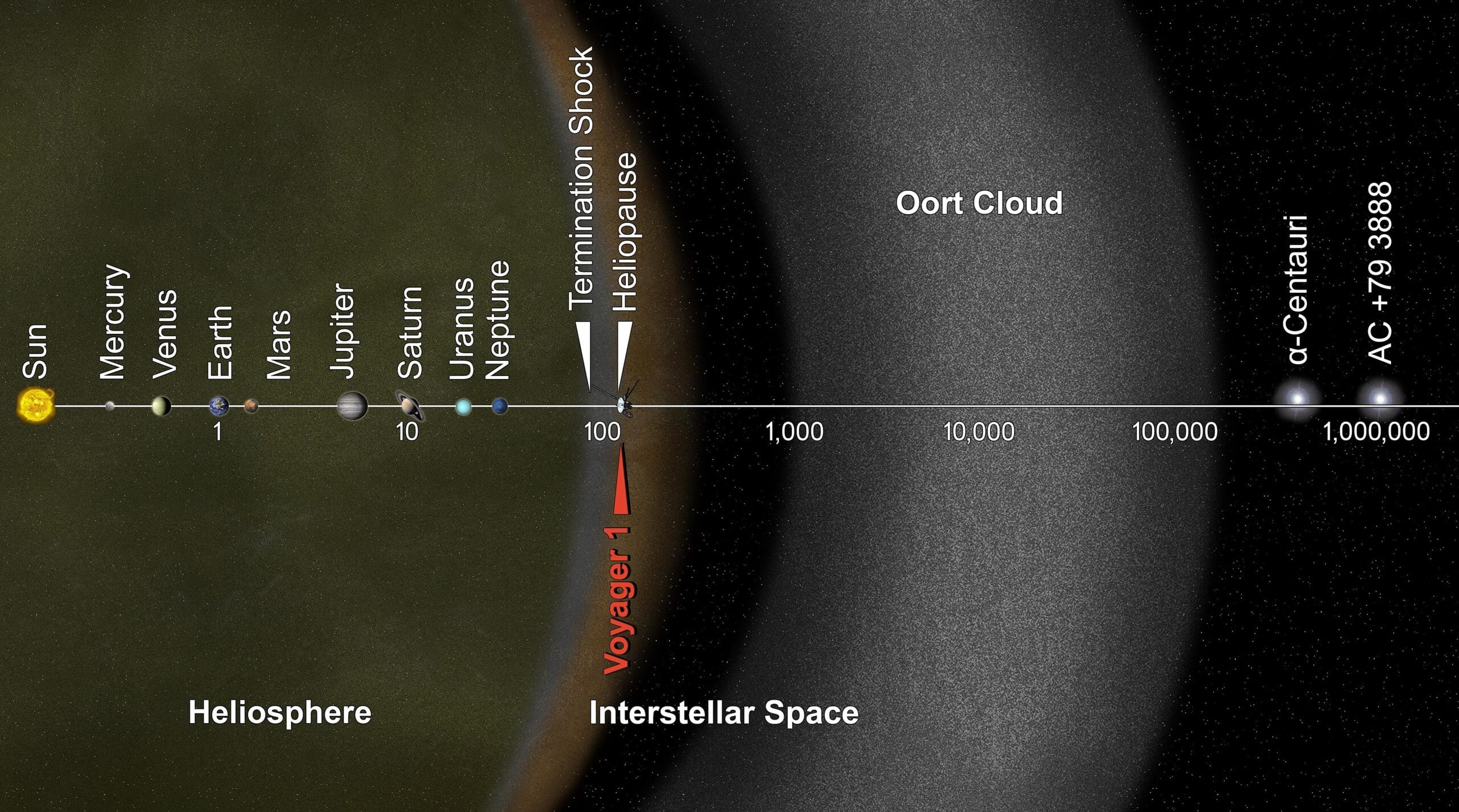


Voyager 1 reaches a full light-day from Earth at 5:16:07 a.m. EST on Wednesday, 18 November 2026, becoming the first human-made object to put 16,094,799,096 miles (25,902,068,356 kilometers) between itself and the planet that built it.
NASA’s public countdown rounds the moment to “NOV 18, 2026, 5:16AM EST.” The agency puts the trip at 49 years, two months, and 11 days from launch to one light-day beyond Earth, and calls Voyager 1 the most distant human-made object.
Voyager 1 launched on 5 September 1977, two weeks after Voyager 2. NASA’s Jet Propulsion Laboratory in Southern California built both spacecraft and still operates them.
A light-day is the distance light travels in 24 hours. For this milestone that is exactly 16,094,799,096 miles, or 25,902,068,356 kilometers. The shorthand used in agency materials, about 16 billion miles (about 26 billion kilometers), is rounded.
The number is a definition rather than an odometer reading. A light-day is a fixed length, and the milestone is the moment Voyager 1’s distance from Earth matches that length.
Light covers about 186,000 miles every second. Voyager 1 cruises at nearly 38,000 mph (61,000 kph), fast by any human standard and slow next to light. The difference between those two speeds is why the crossing took most of 50 years.
For scale, the Moon sits an average of 238,855 miles (384,400 kilometers) from Earth. At that point Voyager 1 will be a full day of light travel away, already flying well beyond the Sun’s bubble.
Astronomers already measure deep space in light travel time, which is what makes the unit useful here. The light-year is the familiar version. The light-day is the one a spacecraft can actually reach.
A command from Earth now takes 24 hours to arrive
Radio signals travel at the speed of light, so the distance mark is also a communications mark. Any light from Earth would take 24 hours to reach the spacecraft, NASA said in a news release updated 13 November 2026.
A signal sent back from Voyager 1, moving at the same speed, would need another 24 hours to cross the same distance. By the same arithmetic, a question and its answer span two days; NASA quotes only the one-way 24 hours.
Any instruction sent to Voyager 1 does not even arrive until a day after it leaves Earth, and word of what happened cannot come back faster than light. Nothing on the spacecraft can be corrected in real time.
Earlier coverage here of the August 2012 interstellar crossing cited a one-way light time of more than 22 hours and a transmit power of about 22 watts. Those were the numbers then. The official figure at this milestone is 24 hours.
The lag shapes how the mission handles trouble. The Deep Space Network heard nothing from the probe on 18 and 19 October, two days without a signal.
The signal returned on 20 October before anyone sent a command. The spacecraft’s computers had already switched one thruster group over to its backups, without instruction from the ground.
Power is the slower problem. Voyager 1’s radioisotope generators lose about four watts every year, which is what limits how long instruments can keep running.
Shine Bright for Voyager’s Light-Day on 17 November
NASA is asking people to mark the crossing the evening before. After sunset on Tuesday 17 November, the agency invites phones, flashlights, and even entire buildings to flash a message toward the sky.
NASA describes it as a symbolic wave of golden light. The flashes will not be seen by Voyager 1. The agency encourages participants to share photos or videos tagged @NASA.
The timing puts the public event the night before the crossing itself, which falls in the early morning on the East Coast, in Eastern Standard Time.
Nothing about the spacecraft changes at 5:16:07 a.m. It keeps moving at nearly 38,000 mph, and the following second puts it past a light-day. The milestone is a marker on a trajectory, not a stop.
Voyager 2 reaches the same distance in November 2035
Voyager 2 is on pace to be one light-day from Earth in November 2035, nine years from now. It launched first but took a different path out, swinging past Uranus and Neptune.
Voyager 1 crossed into interstellar space in August 2012. Voyager 2 followed in 2018. Both now operate beyond the heliosphere, the protective bubble created by the Sun.
Both still gather science from out there, and NASA keeps a running account of where the two spacecraft are now and what they are doing.
The news release says that on 18 November, a spacecraft launched nearly 50 years ago in 1977 will have traveled one light-day from Earth, more than 16 billion miles (25.9 billion kilometers) from home, with the exact light-day figures governing that mark.
JPL will host a moderated discussion on Thursday 19 November at 12 p.m. EST (9 a.m. PST) with mission members and NASA leadership on the status of Voyager 1 and 2 and the unique science the twin probes continue to gather.