

Four University of Washington students in Seattle have built a single-use patch, about the size of a wallet, that a rescuer places on the breastbone of someone in cardiac arrest. Simple LED lights on the patch show the rescuer, in real time, “whether compression depths and rates are effective,” according to the National Inventors Hall of Fame, which named the project, CPRight, first-place undergraduate winner of its 2026 Collegiate Inventors Competition on October 16. The prize was $10,000.
The team is Shubham Bansal, Prisha Hemani, Deeya Sharma and Nikhita Vaddineni, advised by Tristan Jafari. The announcement says the patch itself “does not require any additional technology or equipment” to do its job.
Two university competitions, one patch
The Collegiate Inventors Competition is run by the National Inventors Hall of Fame and sponsored by the US Patent and Trademark Office. This year’s final round had ten teams, five undergraduate and five graduate, made up of 25 students from nine schools, judged by a panel that included Hall of Fame inductees and USPTO officials. Alongside the cash, the winning teams receive a USPTO Patent Acceleration Certificate.
It was CPRight’s second win of the year. Earlier in 2026 the project took the $15,000 Hollomon Family Grand Prize and a separate $2,500 award for the best medical device idea at the Hollomon Health Innovation Challenge, a student contest run by the university’s Foster School of Business.
The pitch rests on one line in the Hall of Fame’s write-up: “Bystanders are often willing to help but are unable to deliver high-quality CPR.”
Two inches deep, 100 to 120 a minute
The American Heart Association’s 2025 adult basic life support guidelines spell out what high-quality means. Rescuers should push “at least 2 inches, or 5 cm,” into an average adult’s chest, but not more than 2.4 inches, at a rate of 100 to 120 compressions a minute. The gap between too shallow and too deep is four-tenths of an inch.
Hitting those targets is harder than it sounds. In the Seattle area, researchers studied 911 recordings of 327 cardiac arrests in which a bystander gave CPR during the first half of 2017, counting compressions from the audio. The bystanders averaged fewer than 100 a minute: 88 in the study’s summary and 90 in its weighted table, both below the guideline’s floor. People being coached by a 911 dispatcher averaged 87 a minute, while those working without coaching averaged 101.
The study, published in the Journal of the American Heart Association in 2021, still concluded that bystander CPR “approached guideline goals.” Working from audio alone, its authors could not assess compression depth at all. Depth is one of the two things CPRight’s lights are meant to show.
Heart attack or cardiac arrest
The Hall of Fame’s announcement says “more than 350,000 Americans experience a heart attack outside a hospital, and about 90% of them die.” That mixes up two conditions. The American Heart Association defines them separately: a heart attack “occurs when blood flow to the heart is blocked,” while cardiac arrest “occurs when the heart malfunctions and stops beating unexpectedly.” Most heart attacks do not lead to cardiac arrest, although a heart attack is a common cause of one. CPR is for cardiac arrest.
With that word corrected, the scale is in line with the AHA’s own. The association puts the number of cardiac arrests outside hospitals at more than 350,000 a year and says they most often happen in homes or residences, 73.4% by its count. The US Cardiac Arrest Registry to Enhance Survival, which covers a population of more than 189 million, logged 140,427 non-traumatic cardiac arrests that emergency crews worked on in 2025. Its 2025 figures put overall survival at 10.5%, so roughly nine in ten did not survive. Bystanders gave CPR in 42.5% of cases, a rate that leaves out arrests in medical settings and those witnessed by 911 responders.
What the announcement leaves out
The idea behind the patch has support in the guidelines. The AHA calls it “reasonable to use audiovisual feedback devices for real-time optimization of CPR performance.” Its evidence review cites a meta-analysis that linked such feedback to more patients regaining a pulse and surviving to hospital discharge. The feedback was not associated with more patients surviving with good brain function, and the review notes that many of the studies built the devices into broader quality improvement programmes.
That evidence concerns feedback in general, not this patch. None of the published accounts of CPRight, from the Hall of Fame, the university’s business school or news coverage of either contest, describes how it senses depth and rate, what readings make its lights change, how it has been tested, what it would cost or whether it is on a path to approval by the US Food and Drug Administration. On the public record it is a judged student invention, not a product.
A light also helps only someone who starts compressions and has the patch to hand. Fewer than half of patients get bystander CPR at all. Covering the March contest, Poets&Quants reported that the patch is designed to fit into AED cabinets and first-aid kits in public spaces. Make Tech Easier has covered another way of getting equipment to a collapse quickly, drones carrying defibrillators to the scene.
The test still to come
Two panels of judges this year put $25,000 behind a single idea: that the two targets in the AHA’s guidelines can be shown to a rescuer as a light on the patient’s chest. What nobody outside the team has published yet is a measurement of whether those lights read depth and rate correctly on a chest, and how often they would be wrong.
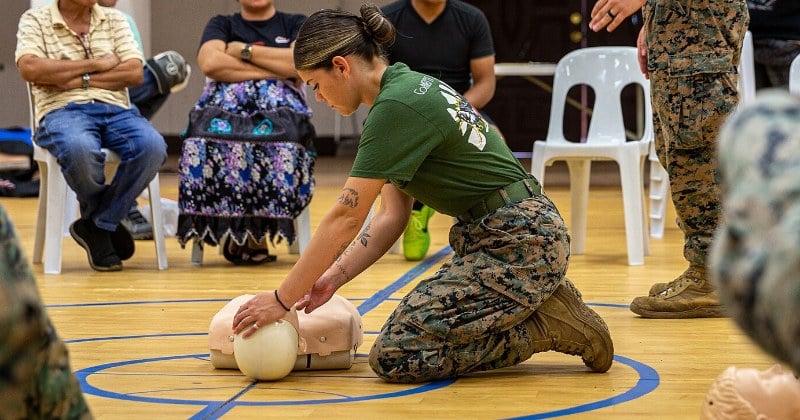
Featured image: A US Marine demonstrates chest compressions on an adult CPR manikin during training in Chuuk, Federated States of Micronesia, in 2023 (representative; not the CPRight patch). Photo: U.S. Marine Corps, Lance Cpl. Trent A. Henry / Wikimedia Commons, public domain; resized.