

Before any fuel moved on June 4, 2021, the crew of a Navy F/A-18 Super Hornet over southwestern Illinois had a job to do: fly up close behind an aircraft with nobody aboard and find out how it behaved.
The tanker was the MQ-25 T1, a Boeing-owned test aircraft flown by an operator at a ground control station on a flight from MidAmerica Airport in Mascoutah, Illinois. The Super Hornet crew, two aviators from the Navy’s Air Test and Evaluation Squadron 23 (VX-23), moved into close formation behind it to check its performance and stability. Boeing says the separation between the drone and the fighter’s refueling probe was as little as 20 feet. NAVAIR says the crew conducted a formation evaluation, a wake survey and drogue tracking before plugging in.
It worked. Over a flight of about four and a half hours, the T1 passed 325 pounds of fuel to the fighter: 300 pounds at around 10,000 feet and another 25 pounds at 16,000 feet, according to Defense News. It was the first time an unmanned aircraft had refueled another aircraft in flight.
More than five years later, the Navy announced that a carrier in the Pacific had taken control of an MQ-25A from more than 2,100 miles away, a ground test covered further down. The refueling flight came first, and it depended on a careful sequence of checks.
How probe-and-drogue refueling works
The T1 carried a Navy-issued aerial refueling store, a pod under its wing with a hose reeled up inside. In flight, the pod lets the hose trail out behind the tanker. At its end is a cone-shaped basket, the drogue, which catches the airflow like a small parachute and keeps the hose stretched out and stable.
The receiving aircraft has a rigid probe near the cockpit. The pilot flies the probe into the basket until it locks in, fuel flows through the hose, and the receiver eases back to pull free. This probe-and-drogue method is the Navy’s standard, and the June flight showed the MQ-25 can carry out its tanker mission using it.
The US Air Force mostly uses a different system, a rigid boom that an operator aboard the tanker steers into a receptacle on the receiving aircraft. With probe-and-drogue, the precise flying is done by the pilot of the receiving aircraft, which suits a tanker with no one on board.
Why the checks came before the connection
With no one aboard the T1, the Super Hornet crew’s evaluation was the practical check on whether the drone, the air behind it and its trailing hose behaved predictably enough to approach. Every aircraft disturbs the air behind it, so the wake survey came before any connection. Drogue tracking came next: the pilot followed the basket to see whether it held steady enough to aim at.
The engineers had done their own groundwork. Boeing says the milestone followed 25 T1 flights that tested the aerodynamics of both the aircraft and its refueling pod across the flight envelope, along with extensive simulations of aerial refueling using digital models of the MQ-25. USNI News reported that the Navy’s first test flight with the refueling store took place the previous December. Those flights answered narrower questions first: whether the pod changed how the aircraft flew, whether the hose and basket behaved consistently at different speeds and altitudes, and whether the flight data matched the simulations.
The crews built up gradually on the day too. The Super Hornet made several “dry” connections, plugging in without taking fuel, to test connecting and disconnecting, and spent more than 10 minutes connected in total, according to Defense News.
Why the Navy wants an uncrewed tanker
Super Hornets fitted with refueling pods have done much of the carrier air wing’s tanking. In 2021, Navy officials said tanking could account for more than a third of Super Hornet flight hours during air wing operations. Handing that job to the MQ-25 is meant to free the fighters for other missions and extend the range of the air wing.
Fitting into a carrier crew’s routine
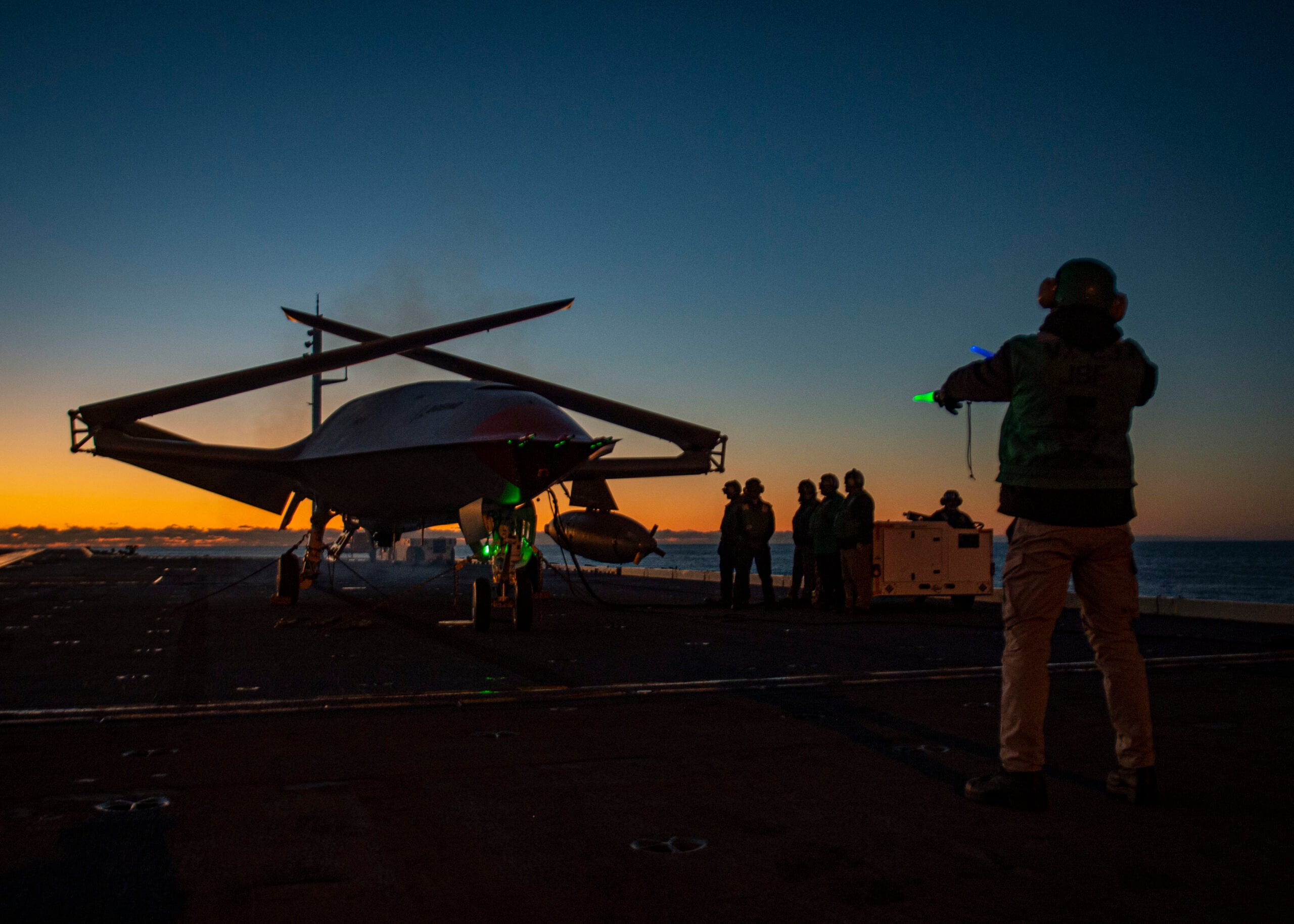
The T1 lacked carrier landing gear and was not hardened for saltwater operations. In December 2021, though, it went aboard USS George H.W. Bush to work out how an aircraft with no pilot would move around a crowded flight deck.
On a carrier, aircraft movement runs on hand signals. Aircraft directors, the “yellow shirts,” guide each jet, and the pilot in the cockpit responds. The T1 had no one in the cockpit to watch them. So Boeing built a handheld Deck Control Device, and MQ-25 “deck operators” stood alongside the Navy’s yellow shirts and entered control inputs in response to the directors’ signals, according to NAVAIR. Together they taxied and parked the aircraft, connected it to the catapult and cleared it from the landing area, in daylight and at night. The team also recorded how deck motion and wind over the deck affected the aircraft’s controllability and its engine.
Below deck, Lockheed Martin installed a prototype MD-5 control station in the ship’s Unmanned Aviation Warfare Center while it was in port, and the Navy’s fleet integration team used it to identify shipboard design constraints and give feedback on the operator interfaces. Capt. Chad Reed, the Navy’s program manager, said the MQ-25 showed it could “maneuver just like a manned aircraft in the shipboard environment.”
Carrier-control demonstration announced in October 2026
By 2026, the program had moved on from the T1. An MQ-25A made its first flight in April 2026, and the Navy now expects initial operational capability in 2029. In October, the Navy announced that its Unmanned Air Warfare Center aboard USS Ronald Reagan, underway in the Pacific, had connected to an MQ-25A test aircraft more than 2,100 miles away over a satellite network. The aircraft stayed on the ground at Boeing’s facility at MidAmerica. Boeing says Navy pilots aboard the ship took control after a formal handoff from the Illinois team, ran a series of operational checks, then handed control back.
That makes it a communications and control test, not a flight. The aircraft did not fly, refuel anything, or launch from or land on Ronald Reagan. Boeing calls it one of a series of buildup exercises ahead of a risk reduction flight-test program that will include carrier operations at sea. Make Tech Easier’s news report on the announcement has more detail.
What each test proved
| Test | Aircraft | What it showed | What it did not cover |
|---|---|---|---|
| June 2021, over Illinois | T1 test aircraft | A crewed fighter can safely approach and take fuel from an uncrewed tanker in flight using probe-and-drogue | Carrier launch and recovery; this was a land-based refueling test |
| December 2021, USS George H.W. Bush | T1 test aircraft | Deck operators can taxi, park and hook the aircraft to a catapult by responding to yellow-shirt signals through a handheld controller, day and night | Launching from or landing on the ship |
| Reported October 2026, USS Ronald Reagan | MQ-25A test aircraft, on the ground in Illinois | A carrier’s control station can take control of the aircraft over a satellite link and hand it back safely | Flight, refueling or carrier launch and recovery |