
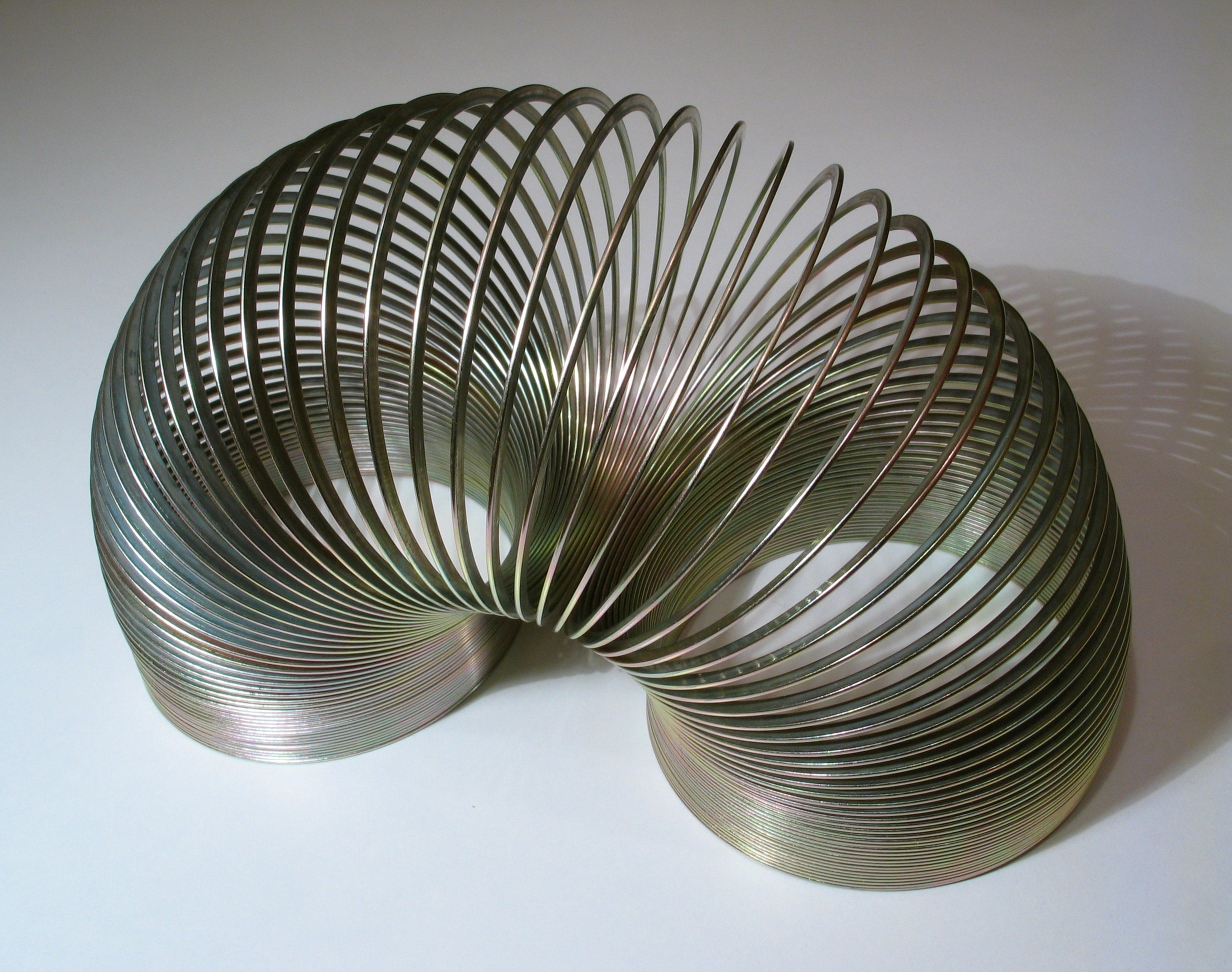


In 1943 Richard James, a mechanical engineer at a Philadelphia shipyard, was working on springs to keep sensitive instruments steady on ships in rough seas when one fell from a shelf and walked down instead of dropping to the floor, according to Lemelson-MIT and Time.
The Encyclopedia of Greater Philadelphia names the yard as Cramp Shipbuilding Co. on the Delaware River.
The Pennsylvania Center for the Book at Penn State University Libraries describes James as a naval engineer during the Second World War.
Lemelson-MIT says the spring “stepped” in a series of arcs from the shelf to a stack of books to a tabletop to the floor, where it re-coiled itself and stood upright. The New York Times in 1996 described the object as a torsion spring.
A spring that walked
Repeated tests showed the spring could climb down stairs. James’s wife, Betty, saw it as a plaything and chose a name from the dictionary. Time puts the naming in 1944. The Encyclopedia of Greater Philadelphia says she picked “slinky,” meaning graceful in movement, after leafing through the pages.
The Navy never took an interest in his springs, according to Lemelson-MIT.
James spent the next two years testing metals and proportions before settling on a workable model. The original Slinky was 2.5 in tall, with 75 ft of high carbon steel wire arranged in 98 coils, Time reported. James had a Philadelphia piston-ring firm make about 450 of them.
Gimbels, on the Market Street East retail corridor, agreed to try the toy during the Christmas rush.
Ninety minutes at Gimbels
On the evening of 27 November 1945 James showed Gimbels shoppers how the Slinky could walk down an incline. He had 400 in stock, priced at $1 each. All 400 sold in 90 minutes.
By the end of the 1945 holiday season 22,000 Slinkys had been sold, according to Time.
James filed a patent the same month as the Gimbels demonstration, and it was approved in January 1947. He quit his job to work on the toy full time. The Jameses rented factory space in Germantown, where James Industries ran six machines turning out 100 Slinkys an hour.
Production later moved to Clifton Heights in Delaware County, then to Hollidaysburg, Pennsylvania, in the mid-1960s. Richard James designed the coiling machines himself. Lemelson-MIT says each one could wind 80 feet of steel wire into a Slinky in about 10 seconds, and the same machines were still in use at the toy’s 50th anniversary in 1995.
Other uses followed, Lemelson-MIT says. High school teachers used Slinkys to demonstrate the properties of waves. US troops in Vietnam used them as mobile radio antennas. NASA used them in zero gravity physics experiments aboard the Space Shuttle.
Richard James left the business and his family in 1960 to join a religious group in Bolivia, and he died in South America in 1974. Betty James ran the company alone from that point. In 1963 she mortgaged her house to show the Slinky at the New York Toy Fair, and she sold the company to Poof Products in 1998.
Lifetime sales figures differ. Time put the total at more than 300 million Slinkys in 2015. The Encyclopedia of Greater Philadelphia gives an estimate of 350 million sold worldwide by 2015.
Sources:
- Lemelson-MIT: https://lemelson.mit.edu/resources/richard-james
- Time: https://time.com/4127170/slinky-70-years/
- Encyclopedia of Greater Philadelphia: https://philadelphiaencyclopedia.org/essays/slinky/
- Pennsylvania Center for the Book (Penn State University Libraries): https://pabook.libraries.psu.edu/literary-cultural-heritage-map-pa/feature-articles/sensational-story-sleek-silver-slinky
- New York Times: https://www.nytimes.com/1996/02/21/garden/talking-toys-with-betty-james-persevering-for-family-and-slinky.html