
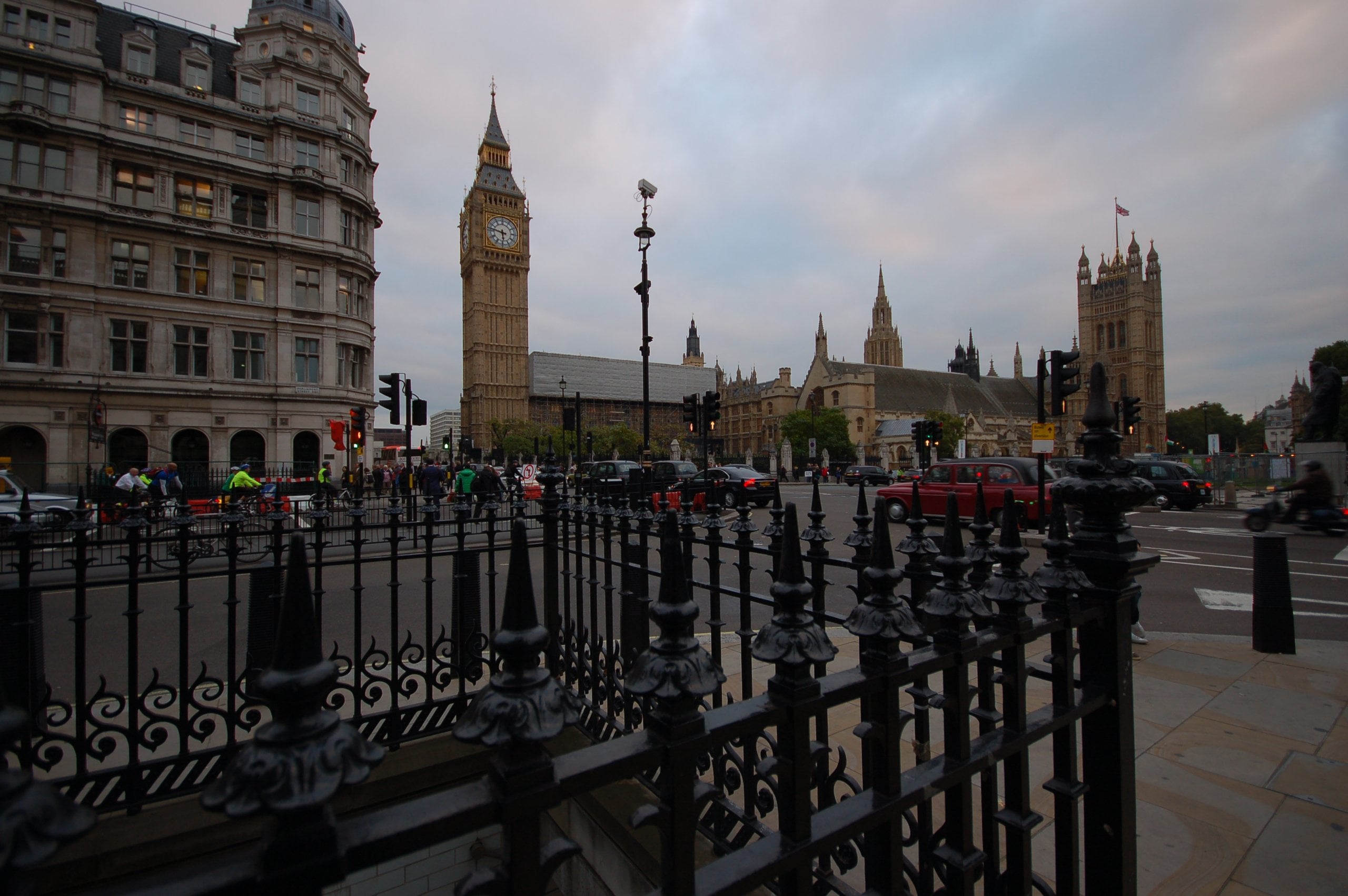


The world’s first traffic light was installed on 9 December 1868 at the junction of Great George Street and Bridge Street in Westminster, according to BBC Nottingham.
Transport for London says the signal stood outside the Houses of Parliament, six metres (20 feet) above the carriageway, and resembled a railway signal, with arms that waved to indicate stop. It had red and green lights but no amber, ran on gas and needed police constables to change it by hand using switches.
The signal was put up to counter the number of people being killed on the roads.
TfL said more than 1,000 people were dying on London’s roads every year, and there were no cars. BBC Nottingham says the concern at the time was the number of horse drawn carriages and the danger they posed to pedestrians.
A railway signal on the road
The designer, John Peake Knight, was a railway manager from Nottingham who specialised in signalling systems. He left his Nottingham grammar school at 12 to join his two brothers in the parcel room of the Midland Railway, and by 25 he was Superintendent of the South Eastern Railway. In 1865 he took his idea to the Metropolitan Police Commissioner.
His plan was to treat main roads and side roads as main and branch railway lines.
Smithsonian Magazine describes how it worked. Coloured arms raised 20 feet above the street switched between two angles. Fully horizontal meant oncoming traffic should stop. Lowered to a 30-degree tilt, the arms meant traffic could proceed with caution. At night, when the arms could not be seen, red and green gaslights signalled stop and go.
The Times found the signal “extremely simple” and “handsome”, as reported by Smithsonian Magazine, and predicted that “similar structures will no doubt be speedily erected in many other parts of the metropolis.”
A reader of the Daily Telegraph, quoted by Smithsonian, called it “a monstrous thing resembling a Brobdingnagian lamp-post”.
The explosion
Less than a month after the signal was installed, a gas line connected to the red and green lights exploded, badly burning the constable operating it, Smithsonian Magazine reports. BBC Nottingham says a leaky gas main caused one of the lights to blow up in his face one evening. TfL says he was seriously injured.
After the explosion The Times wrote, as reported by Smithsonian Magazine: “The roadway all round the pillar has smelt almost from the time the pillar was put up, as if it were soaked with gas.” The paper added: “Surely the powers that be will take warning.”
The project was dropped and a policeman went back to directing traffic by hand.
Electric signals developed in the United States instead, Smithsonian Magazine reports. In 1912 Lester Wire, a 24-year-old traffic officer in Salt Lake City, hooked red and green lights up to trolley wires at an intersection. He never patented the device, but it was copied in cities such as Cleveland and Detroit.
The sources differ on when signals came back to London. TfL says traffic lights did not return to the capital until 1926. BBC Nottingham says they only became a common sight in London in 1929, when the first electric signals were introduced.
When TfL marked the 150th anniversary of the first signal in December 2018, it was responsible for 6,000 traffic signals in London.
Sources:
- Transport for London: https://tfl.gov.uk/info-for/media/press-releases/2018/december/tfl-marks-the-150th-anniversary-of-the-traffic-light
- BBC Nottingham: https://www.bbc.com/nottingham/content/articles/2009/07/16/john_peake_knight_traffic_lights_feature.shtml
- Smithsonian Magazine: https://www.smithsonianmag.com/smart-news/chaotic-traffic-from-horse-drawn-carriages-inspired-the-worlds-first-traffic-lights-180985558/