
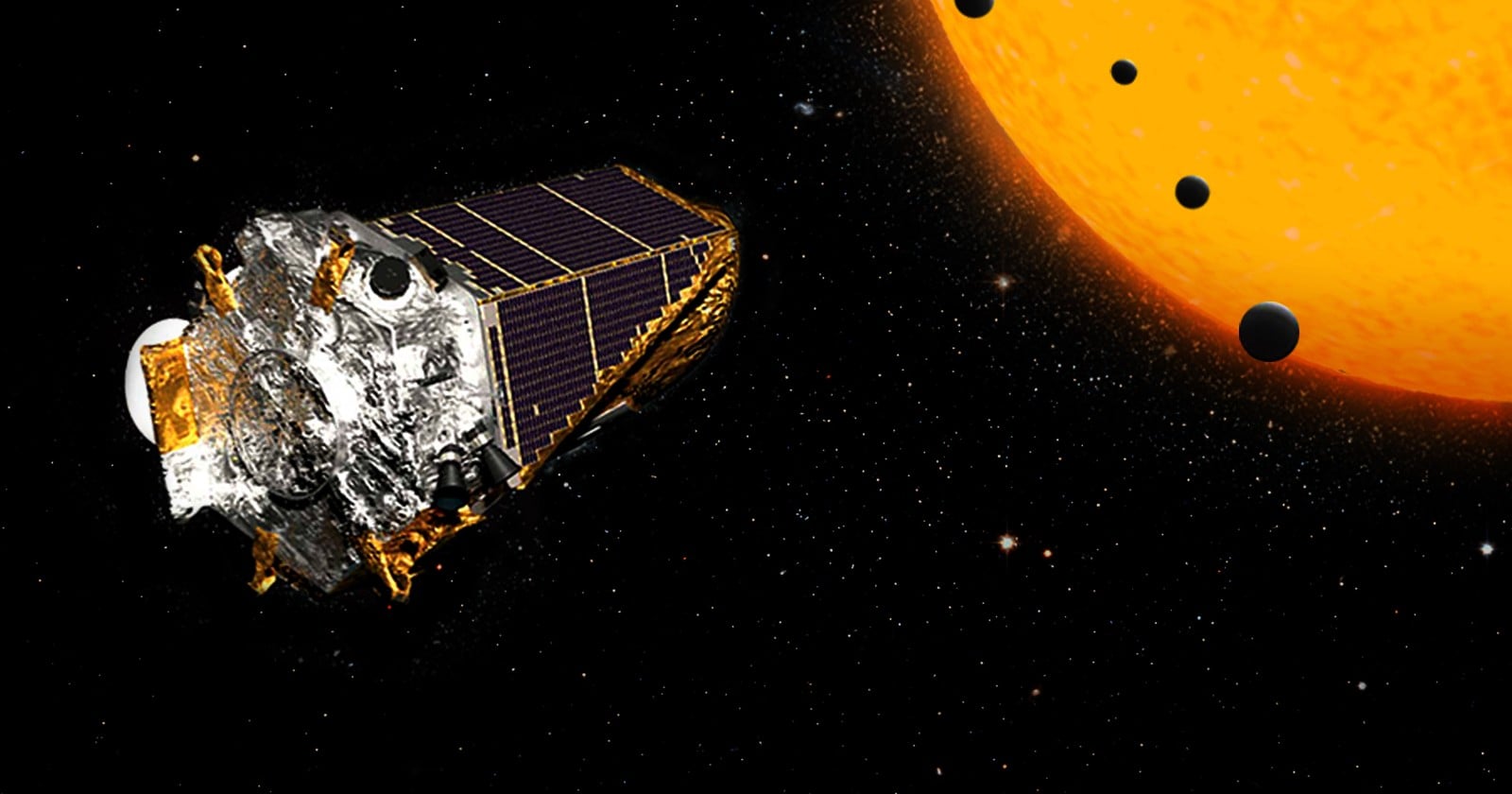

In May 2013, NASA’s Kepler space telescope lost the second of the four reaction wheels it used to hold itself steady. It could no longer stay locked on the patch of sky it had watched since 2009, and its original planet-hunting survey was over.
The telescope and most of its camera still worked. The team’s problem was how to hold them steady enough to keep doing useful science. Within a year, engineers had turned Kepler into a new mission, K2, by using the pressure of sunlight to help balance the spacecraft.
What broke, and what still worked
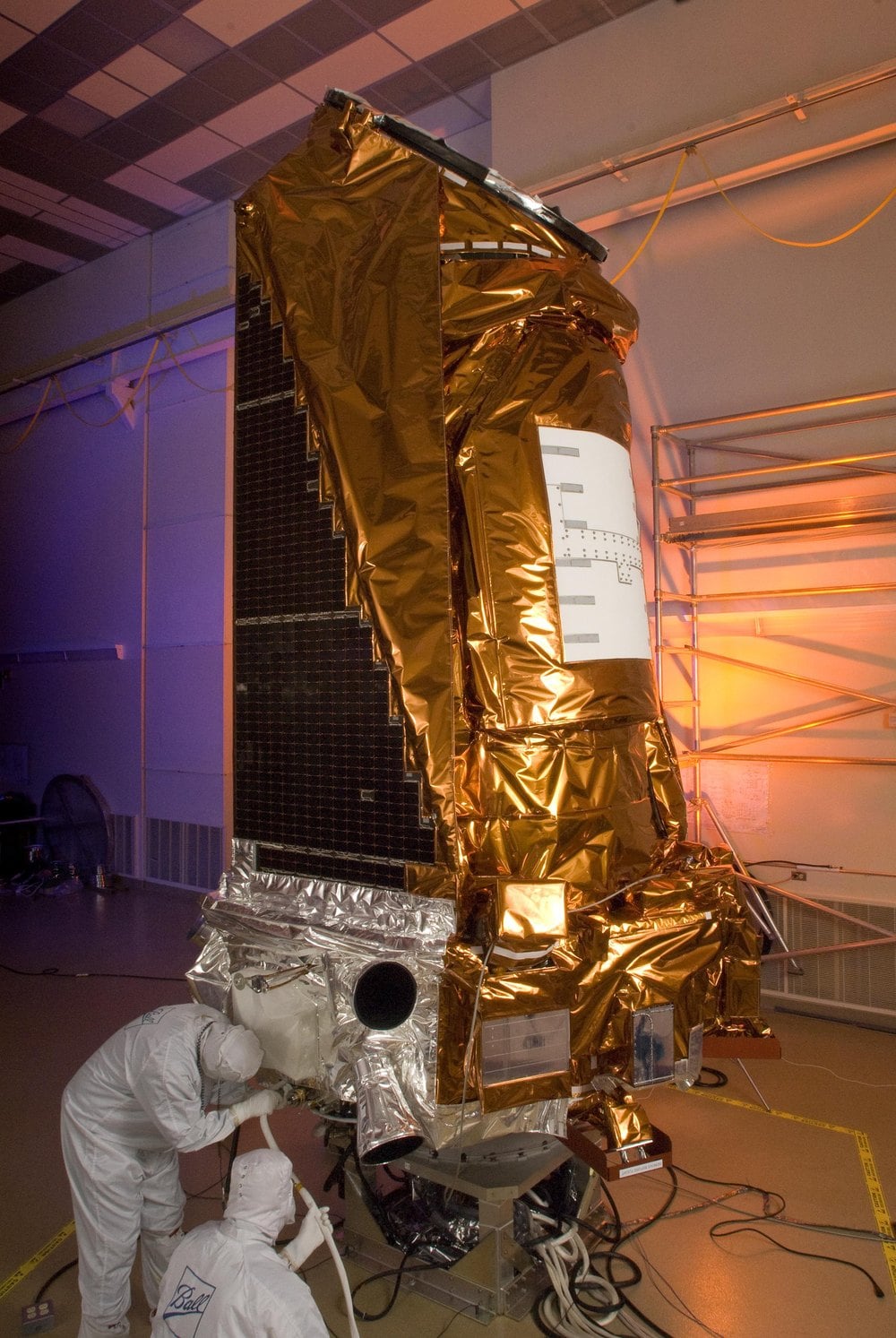
Reaction wheels are motor-driven flywheels. Changing their spin speed applies an opposing torque to the spacecraft, letting it turn or resist unwanted rotation without firing thrusters. Kepler used four wheels for three-axis control, giving it enough redundancy to survive one failure. Losing a second left its original pointing system unable to control all three axes.
The first wheel failed in July 2012 and the second in May 2013. In their 2014 account, Ball Aerospace’s operations engineers described a last attempt that August to point with three wheels, including one of the failed ones. Within hours the damaged wheel fell behind, and they concluded that three-wheel operation was “not a viable option in any capacity.”
The difficulty was steadiness. Kepler found planets by measuring stars’ brightness and watching for the tiny dip when a planet passes in front of one. An Earth-size planet crossing a Sun-like star dims it by about 84 parts per million, and catching that required pointing stable to about 0.01 arcsecond, according to mission founder William Borucki. With two wheels, Kepler could still control where the telescope pointed, but not its roll around that direction.
How sunlight could stand in for a missing wheel
Light carries momentum, so sunlight pushes on whatever it hits. At Earth’s distance from the Sun, sunlight delivers about 1,361 watts per square meter. Dividing by the speed of light gives a pressure of roughly 4.5 micronewtons per square meter for fully absorbed light: by our arithmetic, about the weight of half a milligram resting on each square meter.
The push never lets up. Kepler orbits the Sun far from Earth, out of reach of air drag and Earth’s magnetic field, so sunlight was the dominant source of external pointing disturbance. If sunlight presses harder on one side of the spacecraft’s balance point than the other, it also produces a twist.
The idea that rescued Kepler was to arrange for that twist around the roll axis to cancel out. Jenkins, a NASA Ames scientist on the mission, credits it to “a clever engineer at Ball, Doug Wiemer.” Kepler’s solar array is roughly symmetric about a central ridge. With sunlight falling evenly on both sides of that ridge, the turning effects on the two sides largely cancel, leaving little roll torque. Sunlight still pushes on the spacecraft as a whole. The two remaining wheels absorb its turning effects about the other two axes, and thrusters periodically dump the momentum the wheels build up.
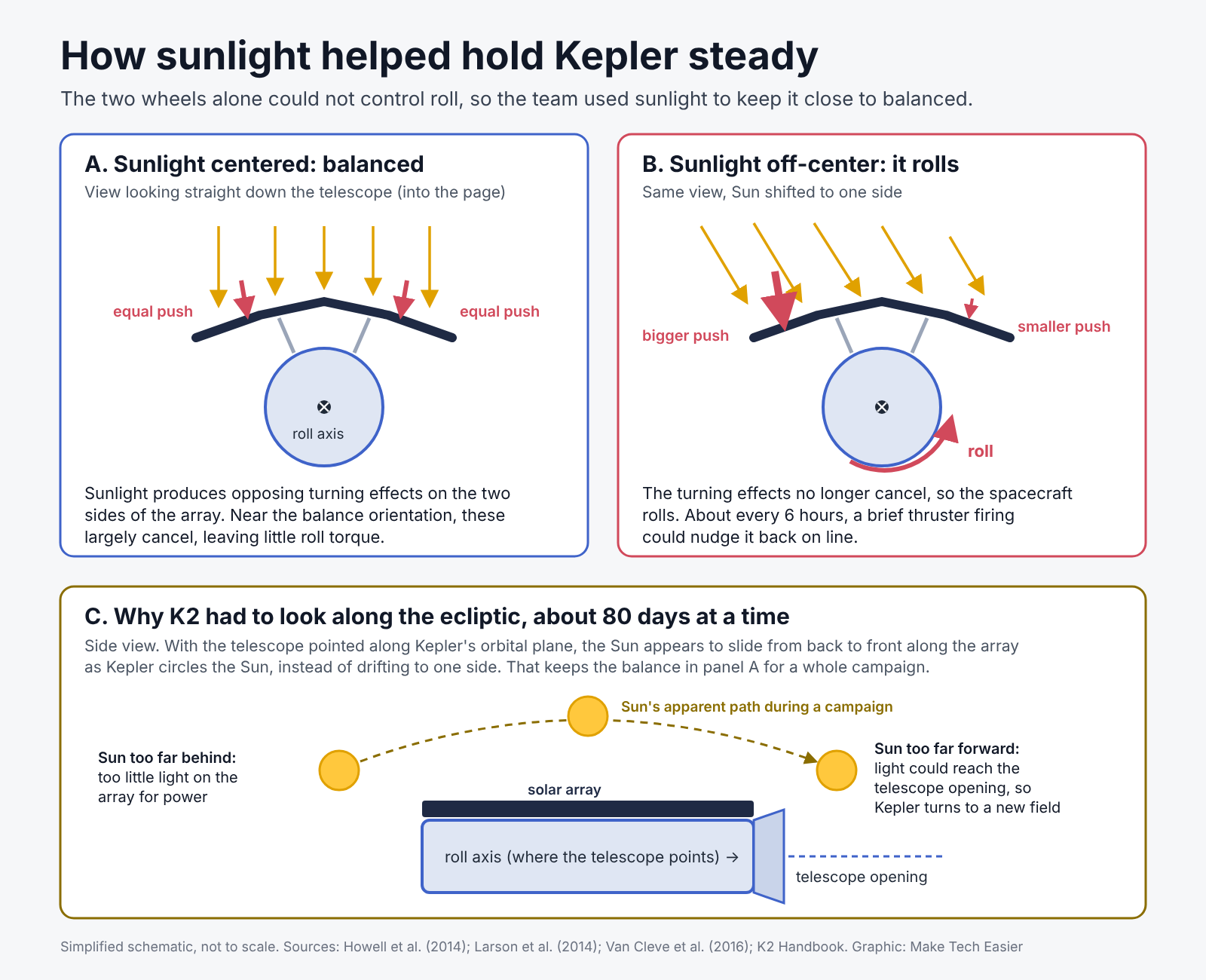
The balance was never perfect. The mission team’s 2016 performance paper compared it to balancing a pencil on a fingertip. According to the K2 Handbook, after about every six hours of observations the spacecraft decided on its own whether a thruster firing, typically 20 to 100 milliseconds long, was needed to bring the roll back into line.
That is what the shorthand “sunlight became the third wheel” leaves out. Sunlight could not steer the spacecraft. It only kept the roll drift slow near the balance points, and the thrusters did the rest. As the Ball engineers put it, “perfect balance is impossible to achieve.”
From a sketch to a test in five months
The team had about five months before a proposal was due for NASA’s senior review, which would decide whether Kepler kept its funding. On August 29, 2013, about two weeks after the attitude-control engineers presented the concept, Kepler held its pointing on two wheels for the first time.
The harder part was learning how imperfect the balance was. Tests that autumn showed the drift rate changing sharply with the Sun’s angle on the array, because the spacecraft is not perfectly symmetric, so the team mapped the drift across every angle a campaign would cover. Testing also burned propellant: by the end of 2013, a rough estimate gave less than two years of campaigns, until changes to how and when the thrusters fired stretched it past three.
In a 30-day test in early 2014, Kepler recorded the transit of a known Jupiter-size planet, WASP-28b. The Ball engineers wrote that they had taken the idea from “PowerPoint concept to on-the-ground proof of planet detection in less than five months.” NASA approved K2 in May 2014.
The trade-off: a different mission
The balance held only while the telescope pointed along Kepler’s orbital plane, close to the ecliptic, the path the Sun and planets trace across our sky. Even there, the Sun’s apparent position shifts as Kepler orbits. After roughly 80 days, the Sun would be either too low over the solar array to provide enough power or too close to the telescope opening, so the spacecraft had to turn to a new field. The 2016 performance paper, covering K2’s early campaigns, put numbers on the difference:
| Original Kepler mission | K2 | |
|---|---|---|
| Where it looked | One field in Cygnus and Lyra | A series of fields along the ecliptic |
| How long it watched | The same stars for about four years | Each field for about 80 days |
| Pointing at the edge of the view | Within 0.1 pixel | Within 1.4 pixels for 95% of a campaign |
| Room for targets | About 170,000 | About 15,000 to 25,000 per campaign |
Those limits changed which planets the spacecraft could find. An Earth-like planet takes about a year to orbit a Sun-like star, and, as Borucki has written, the original mission required at least three transits for each detection, so Kepler was designed to watch one field for years. A planet that crosses its star once a year cannot transit more than once during an 80-day campaign, and most such planets would not transit at all while K2 was watching. K2 was better suited to planets on short orbits.
K2 also gained new targets along the ecliptic, from star clusters to supernovae and objects in our own solar system. In a 2018 NASA Ames podcast, Jenkins called losing the second wheel “the best/worst thing” that happened to Kepler, and described K2 as “in many ways, almost as good as Kepler, and in some ways better than Kepler.”
The second rescue: making wobbly data usable
Kepler’s science depended on photometry, measuring a star’s brightness, and on light curves, the record of that brightness over time. Its detectors are not perfectly uniform. Sensitivity varies from pixel to pixel and across each pixel. That hardly mattered when stars stayed put. In K2, roll drift moved stars near the edge of the field by about a pixel every six hours, so their measured brightness rose and fell as they slid across uneven pixels. The 2016 paper reported that uncorrected light curves showed a sawtooth pattern of several percent, more than 100 times larger than the precision Kepler had achieved. An Earth-size transit is less than a hundredth of a percent.
Harvard-Smithsonian Center for Astrophysics graduate student Andrew Vanderburg and astronomer John Johnson published one of the first effective fixes in 2014. Because roll drift pushes each star along nearly the same short arc again and again, they measured where the star sat on that arc in every frame, worked out how its brightness depended on that position, and divided the effect out. The software could correct much of the brightness variation caused by drifting images, even though the spacecraft continued to wobble. On data from a February 2014 engineering test, the method made light curves 2 to 5 times less noisy and brought typical precision to within a factor of two of the original mission.
Why a wobble cost most of the targets
The pointing problem also reached the spacecraft’s storage. Apart from an occasional full-frame snapshot, Kepler saved small boxes of pixels around each chosen star to an onboard recorder and sent them to Earth later. The 2016 performance paper traces how the drift squeezed that system:
- Bigger boxes. Because a star’s position could no longer be predicted to within 0.1 pixel, each box needed extra rings of pixels, called halos, to keep the star inside. The smallest box grew from 12 pixels in the original mission to 30 near the center of the field and 56 near the edge. Halos typically doubled to quadrupled the pixels per target.
- Worse compression. Kepler’s data compressed well because each pixel changed little from one frame to the next. With stars moving, consecutive frames differed more. Kepler had needed about 4.6 to 5.4 bits per pixel. K2 typically needed about 8, and up to 12 in crowded areas near the edge of the field.
- Fewer stars. Both effects had to fit into the same recorder. The paper estimated that room for targets fell from 170,000 in the original mission to between 15,000 and 25,000 per campaign, depending on how crowded the field was.
A mechanical failure changed how the spacecraft pointed. That changed the data, which required new processing, and the data budget, which forced harder choices about which stars to watch.
A planet found in a test run
K2’s first confirmed planet came from that February 2014 engineering test, before the mission had been approved. After correcting for the spacecraft’s motion, Vanderburg and his colleagues spotted a single dip of about 0.1% in the light of a star called HIP 116454.
One dip is not enough to claim a planet, and the short test could not show a repeat. Their follow-up study measured the star’s wobble with the HARPS-North spectrograph in the Canary Islands, revealing a planet on a 9.1-day orbit, and observations from Canada’s MOST space telescope confirmed the transit. NASA announced HIP 116454b in December 2014.
The discovery shows the rescue’s parts working together: the sunlight balance held the telescope steady enough to collect the data, the motion correction recovered the transit, and other telescopes supplied the repeat measurements one short observation could not.
K2 kept observing until 2018. NASA says the team originally expected enough fuel for about 10 campaigns, and the spacecraft reached Campaign 19 before it ran out and was retired on October 30, 2018. As of October 20, 2026, the NASA Exoplanet Archive lists 550 confirmed planets discovered by K2.
None of that restored the original mission. K2 could not stare at one field for years or search for Earth-size planets in year-long orbits. What the team saved was much of the original precision in measuring stellar brightness, at the cost of the long stare, fewer stars per field and a great deal of new software. Saving the telescope meant deciding which of its abilities were still worth keeping and redesigning the mission around them.