
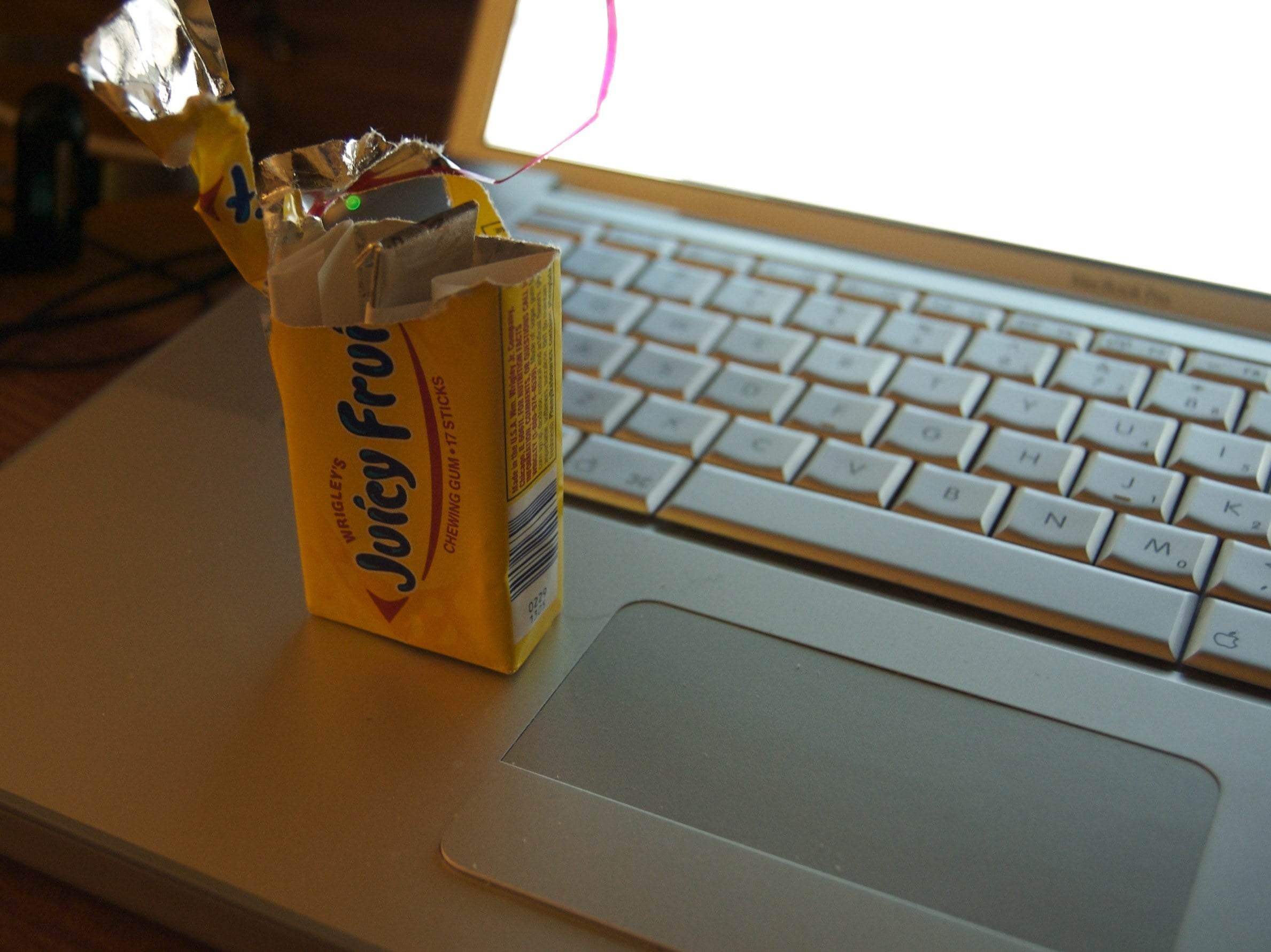


Just after 8 a.m. on 26 June 1974, the first item marked with a Universal Product Code was scanned at the checkout of Marsh Supermarket in Troy, Ohio, according to Smithsonian Magazine. The shopper was Clyde Dawson, head of research and development for Marsh, and the cashier was Sharon Buchanan.
Legend has it, the magazine says, that Dawson pulled a multi-pack of Wrigley’s Juicy Fruit chewing gum from his basket.
The night before, Marsh staff put bar codes on hundreds of items in the store while National Cash Register installed its scanners and computers. NCR, which supplied the checkout equipment, was based in Ohio at the time. Troy was also the headquarters of the Hobart Corporation, which made weighing and pricing machines for loose items such as meat.
Why chewing gum
Dawson said later that the choice was not a lucky dip, according to the magazine. Nobody had been sure that a bar code could be printed on something as small as a pack of chewing gum, and Wrigley had found a solution to the problem.
The magazine says the reward for Wrigley was a place in American history.
The Smithsonian’s National Museum of American History did not collect the gum, the magazine says in an editor’s note dated 26 June 2017. A facsimile was once on display that told the story of the UPC scanner.
From a beach in Miami
The idea came from Joe Woodland, who drew the first bar code with his fingers in the sand at Miami Beach in January 1949. Woodland, who had graduated from Drexel Institute of Technology in Philadelphia in 1947, had left graduate school in the winter of 1948 to live in an apartment owned by his grandfather.
Morse code, which he had learned in the Boy Scouts, gave him the idea.
Woodland said: “Now I have four lines and they could be wide lines and narrow lines, instead of dots and dashes.” Seconds later, with his fingers still in the sand, he swept them round into a circle.
The problem had reached him through Bernard “Bob” Silver, a junior postgraduate at Drexel who overheard a supermarket manager plead with a dean for a way to get shoppers through his store more quickly. The dean shrugged him off. Silver mentioned it to Woodland, who decided to take on the challenge.
Woodland and Silver filed a patent in 1949, and it was granted in 1952. A prototype in Woodland’s home used a 500-watt incandescent bulb and an oscilloscope to read the code, and the whole thing was the size of a desk. The magazine says an evaluation judged it 20 years ahead of its time.
What the two men lacked was a minicomputer and a very bright light.
Theodore Maiman, a research scientist at Hughes Aircraft Company in Culver City, California, produced that light. The company announced his laser at a press conference at the Delmonico Hotel in New York on 17 July 1960, the day after Carl Byoir, its head of public relations, first saw it.
“I did not foresee the supermarket check-out scanner or the printer,” Maiman wrote.
Woodland died in 2012 at the age of 91, the magazine says.
Sources:
- Smithsonian Magazine: https://www.smithsonianmag.com/innovation/history-bar-code-180956704/