
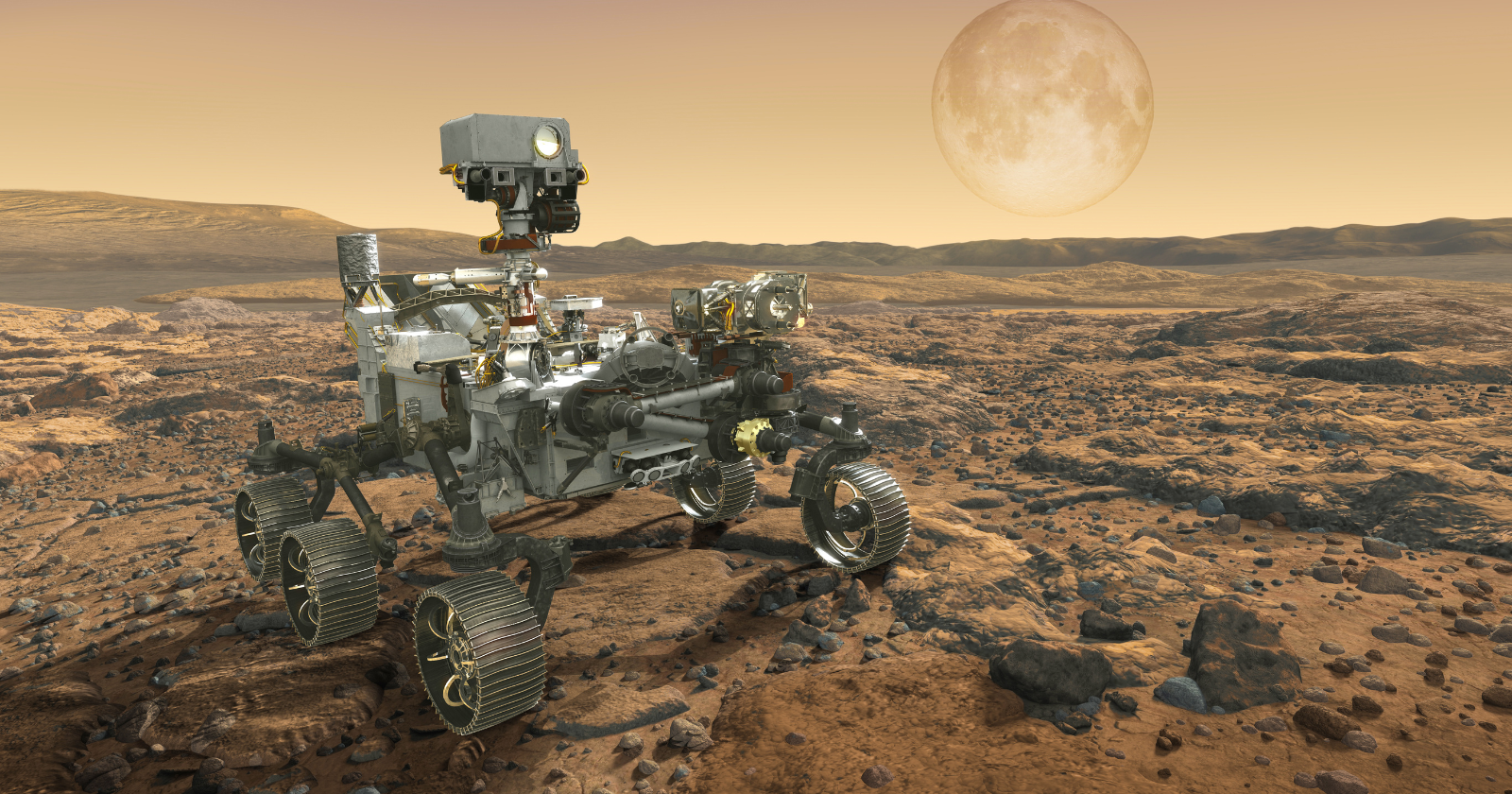

On February 18, 2021, a car-sized robot lowered itself onto the surface of Mars on cables dangling from a rocket-powered crane, a maneuver of almost absurd precision — steered, at the crucial moment, by a processor first sold to consumers inside a bubbly translucent desktop computer in 1998.
The brain of NASA’s $2.9 billion Perseverance rover is, at its core, the same chip that ran the original iMac G3: the PowerPC 750. It is roughly a quarter-century out of date, laughably slow by the standards of the phone in your pocket, and it is exactly what NASA wanted.
The iMac chip, gone to Mars
The PowerPC 750 was a star of the late 1990s — a single-core CPU running around 233 MHz, notable enough in its day to help rescue Apple’s fortunes inside the candy-colored iMac.
Perseverance doesn’t run the consumer version. It runs a specially rebuilt cousin called the RAD750, made by BAE Systems, that keeps the PowerPC 750’s logic and instruction set but is engineered for a place with no mercy for electronics. It runs between 110 and 200 MHz and works with a couple hundred megabytes of memory — figures that would embarrass a decade-old smartphone. And each one costs more than $200,000.
That price is the tell. You are not paying for performance. You are paying for a chip that refuses to die.
Why speed is the wrong thing to want
Mars is a shooting gallery for electronics. It has almost no atmosphere and no magnetic field to speak of, so the solar and cosmic radiation that Earth’s air quietly absorbs slams straight into anything on the surface. A single charged particle ripping through an ordinary processor can flip bits, inject electronic noise, and corrupt or destroy the chip — one bad cosmic ray and a billion-dollar mission is dead on arrival.
So the RAD750 is “radiation-hardened,” rebuilt at the transistor level to shrug off punishment that would instantly kill a normal CPU. Its rating is genuinely staggering. It can absorb up to 1,000,000 rads of radiation and keep working. For scale: a dose of about 600 rads to a human causes the gastrointestinal system to fail, killing a person within about two weeks, and more than 5,000 rads can kill in days. The chip steering Perseverance can take a dose more than a thousand times human-lethal and not miss a calculation. It also operates from −55 to 125°C, across the brutal swing between a Martian day and night.
None of that ruggedness comes from being fast. It comes from being simple, old, exhaustively understood, and physically fortified — qualities that are the opposite of cutting-edge.
Reliability is a technology too
There’s a deeper logic here that runs against every instinct trained by consumer gadgets, where newer is always better.
For a machine that will spend years alone on another planet with no possibility of a repair visit, the single most valuable trait a component can have is that it never fails. A modern chip is millions of times faster, but it is also more delicate, less proven, and packed with tiny features that a stray particle can more easily disrupt. NASA doesn’t need Perseverance to think fast. It needs Perseverance to still be thinking at all in ten years. The RAD750 earns its place not despite being old but because it is old — every quirk mapped, every failure mode catalogued over decades of use in roughly a hundred satellites and spacecraft, from the Kepler telescope to Curiosity to the Juno probe at Jupiter.
The processor’s job on the rover is modest by desktop standards anyway: run the flight software, manage the instruments, execute the daily command sequence beamed from Earth. The heavy lifting of, say, analyzing images is often handled by separate specialized hardware. The main brain just has to be unkillably reliable.
The most expensive slow computer ever built
Step back and the RAD750 becomes a small parable about what “advanced” actually means.
By every number a shopper cares about — clock speed, memory, transistor count — the computer on Perseverance is a museum piece, outclassed by a child’s tablet and priced like a house. Judged by the only metric that matters where it lives, it is one of the most advanced computers ever made: a machine engineered to take a thousand times the radiation that would kill a person, swing through 180 degrees of temperature, and keep running flawlessly, untouched by human hands, tens of millions of miles from the nearest technician.
Speed is cheap and fragile. Survival is expensive and rare. NASA spent $200,000 a chip to buy the one that consumer computing threw away, because on Mars the question is never how fast your computer is. It’s whether it will still answer in the morning. The iMac’s processor got a second life as one of the toughest objects in the solar system — the same silicon that once played QuickTime clips on a beige desk in 1998, now driving across a dead planet and, so far, refusing to quit.