
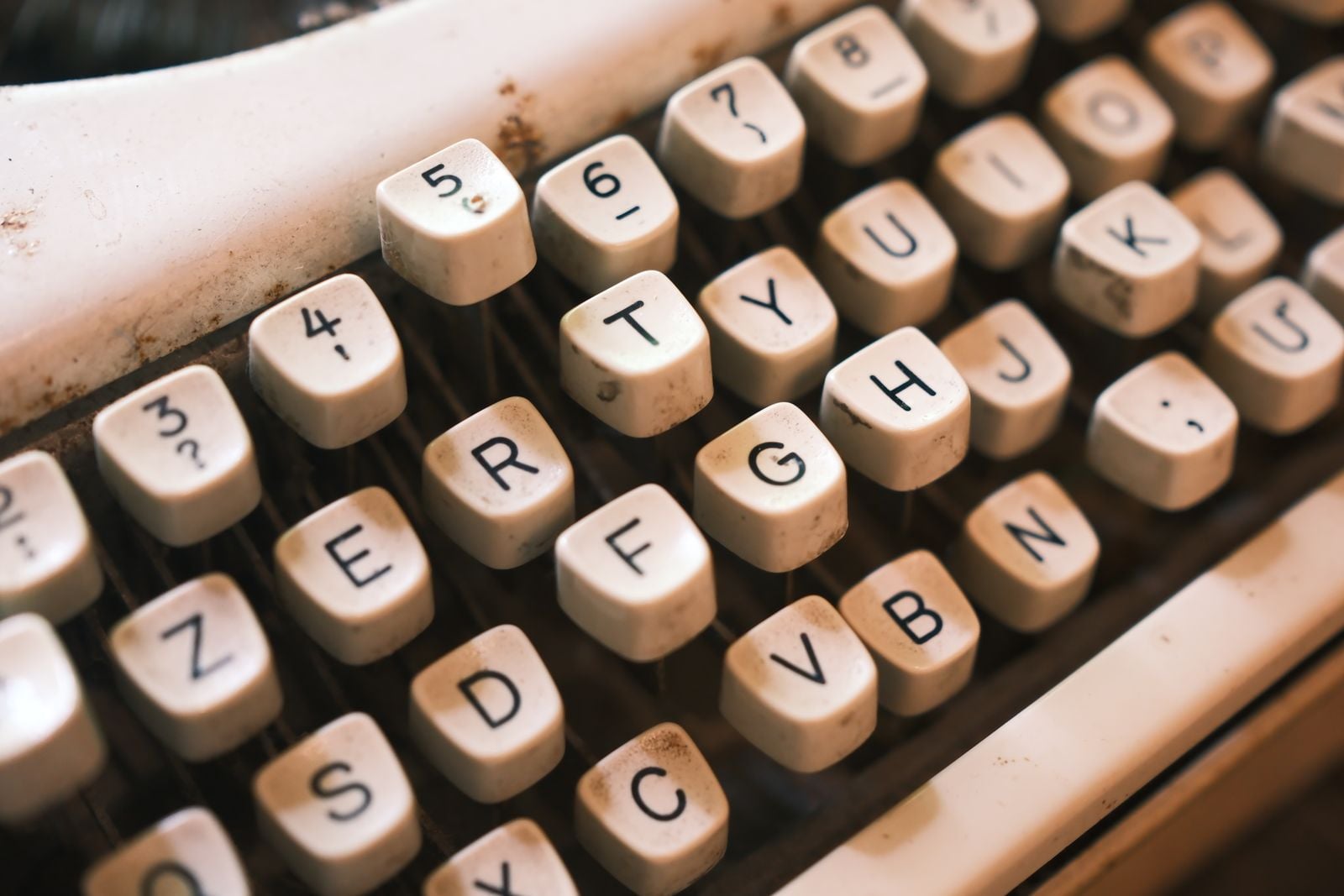

The layout on almost every keyboard in the English-speaking world was fixed in the early 1870s by Christopher Latham Sholes, a Milwaukee newspaper editor tinkering with a writing machine in a machine shop above a foundry. By the time E. Remington and Sons started shipping the Sholes and Glidden Type-Writer in 1874, the top row already read Q-W-E-R-T-Y. It has barely moved since.
The received wisdom is tidy: Sholes arranged the keys to slow typists down so the mechanical typebars would stop clashing. That is close enough to be repeated everywhere and wrong enough to be worth correcting.
What Sholes actually did
Sholes went through several arrangements between 1868 and 1873. His early patents show a near-alphabetical layout across two rows. The problem was mechanical: on his design, each key drove a metal typebar upward into a single striking point, and adjacent bars that fired in quick succession tended to collide and jam. The fix was to separate letter pairs that appeared often together in English — not to slow the hand, but to keep the bars apart in the basket.
The definitive archival study is Koichi Yasuoka and Motoko Yasuoka’s “On the Prehistory of QWERTY” (Kyoto University, 2011), which traces the layout through Sholes’s prototypes and Remington’s revisions. Their reading of the record is blunt: the arrangement was shaped by telegraphers transcribing Morse, by the mechanics of the typebar basket, and by Remington’s manufacturing choices — not by a deliberate campaign to hobble the typist. “R” reportedly moved into the top row late so a salesman could hammer out “TYPE WRITER” using only that row during demonstrations.
So the folk version — Sholes sat down and slowed typists on purpose — collapses on contact with the patents. The mechanical-separation version survives. The two often get blurred into one.
The challengers, and what the tests actually showed
The most famous rival is the Dvorak Simplified Keyboard, patented in 1936 by August Dvorak and William Dealey. It puts the most common English letters on the home row and balances the load between the hands. Dvorak’s own studies, and decades of enthusiast reports, claimed large gains in speed and comfort.
The claim that Dvorak is dramatically faster rests on shakier ground than its supporters usually admit. A 1956 study by the US General Services Administration, led by Earle Strong, compared retrained QWERTY typists against Dvorak typists and found no meaningful productivity advantage for Dvorak once retraining costs were counted. The economists Stan Liebowitz and Stephen Margolis re-examined the historical record in their 1990 Journal of Law and Economics paper “The Fable of the Keys” and concluded that the evidence for Dvorak’s superiority is thin, often self-reported, and frequently traces back to Dvorak himself, who held the patent.
That does not mean Dvorak is worse. Careful modern comparisons — including work on layouts like Colemak, which changes only 17 keys from QWERTY — suggest small ergonomic gains and modest reductions in finger travel. What the record does not show is the large, repeatable speed gap the folklore promises. Top competitive typists exist on both QWERTY and Dvorak, and the ceiling for a trained typist on QWERTY sits well above 150 words per minute.
The interesting question is not which layout is fastest in a lab. It is why the market never moved even when a rival was plausibly a little better.
Lock-in, and why it is not quite the standard story
Economists like to use QWERTY as the classic example of path dependence: an inferior standard captures the market early, users invest in learning it, manufacturers build for the trained users, schools teach the standard the manufacturers build for, and the loop closes. Paul David’s 1985 paper “Clio and the Economics of QWERTY” in the American Economic Review made this the textbook case.
Liebowitz and Margolis pushed back. Their argument is that QWERTY’s persistence is not evidence of a market trapped by a bad standard, because the alternative was never clearly better by enough to justify the switching cost. If Dvorak offered a five per cent improvement and retraining a touch typist takes months of reduced output, the arithmetic favours staying.
Both sides of that debate agree on the mechanism, even if they disagree on the verdict. Once a generation of typists learned QWERTY on Remington machines in the 1880s and 1890s, the cost of coordinating a switch — retraining every clerk, replacing every machine, rewriting every typing manual, changing every typing-school curriculum — grew faster than any plausible benefit from a better layout.
Then the typewriter market consolidated. Underwood, Remington, Royal and Smith Corona all shipped QWERTY. Touch typing, formalised by Frank McGurrin in the 1880s and popularised after his famous 1888 speed contest in Cincinnati, was taught on QWERTY. By 1900 the layout was no longer a design decision. It was infrastructure.
How the layout survived the jump to electronics
Every technology shift after the typewriter had a chance to reset the standard, and none did. The IBM Selectric of 1961 replaced typebars with a spinning golf-ball element — the original mechanical reason for separating common letter pairs was gone — and IBM kept QWERTY. Teletype machines kept QWERTY. Early computer terminals kept QWERTY because the operators had been trained on Teletypes.
When personal computers arrived, the IBM PC’s 1981 keyboard was QWERTY. The Apple II, the Commodore 64, and every serious workstation shipped QWERTY. Operating systems from DOS onward let users switch to Dvorak in software — the option has sat inside Windows and macOS for decades — and almost no one uses it.
The smartphone was the clearest opportunity for a break. A touchscreen has no mechanical constraint at all. The first iPhone in 2007 shipped a QWERTY soft keyboard anyway, because the people buying it already knew where the letters were. Autocorrect, swipe input and predictive text now do more to determine typing speed on a phone than the layout does.
Software layouts like Dvorak and Colemak are one settings menu away on every modern operating system. The cost of switching, in pure software terms, is trivial. The cost of retraining the hands is not.
What the record actually supports
Strip the story down to what the sources will bear, and it looks like this. Sholes arranged QWERTY in the early 1870s to solve a mechanical jamming problem on his prototype and to accommodate the workflows of the telegraph operators who were among the first users. Remington’s manufacturing and marketing froze the arrangement. A generation of trained typists made the layout self-reinforcing before the twentieth century had properly started.
Later layouts, Dvorak among them, may be marginally more comfortable or marginally faster for some users. The evidence for a decisive advantage large enough to overcome the retraining cost is not there. Each new generation of hardware inherited QWERTY from the last because the users were already trained, and the users were already trained because the hardware had been QWERTY.
The keyboard is not the only piece of computing where an early decision hardened into infrastructure and outlived its reason. It sits alongside the way filesystems handle deletion and the reason screens use red, green and blue — engineering choices whose logic has quietly outrun the constraints that produced them.
The typebars have been gone for sixty years. The layout is still here.