
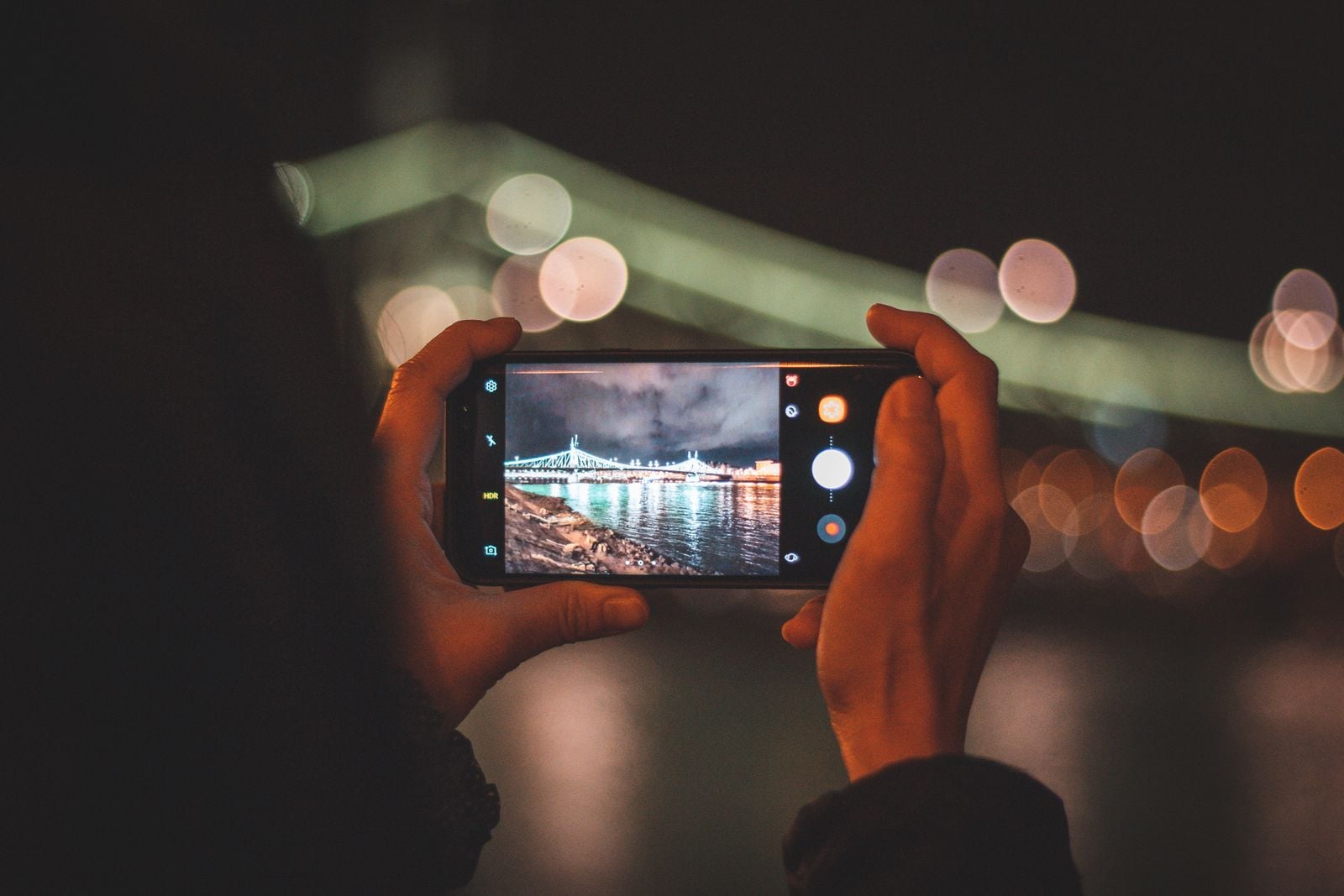

Pixel 3 Night Sight can spend about five seconds making one handheld night photograph from as many as 15 separate frames. In Google’s description of Night Sight, a handheld capture can use 15 exposures at 333 milliseconds each, then align and merge them into a cleaner final image.
The important part is that the picture is not necessarily finished when the shutter button is tapped. In sufficiently dark conditions, Night Sight can keep collecting frames for several seconds while the person holding the phone tries to remain still.
This is one version of computational photography: the camera treats several sensor readings as raw material for one photograph. Google built Night Sight around burst processing, while Apple also uses multi-frame processing in features such as Night mode and Deep Fusion, introduced with the iPhone 11 generation.
Why one long exposure is not enough
Leaving a shutter open longer gathers more photons, which is useful when the scene is dark. But on a handheld camera, a longer exposure also gives the phone and anything in front of it more time to move, turning edges into streaks instead of detail.
There is no universal 1/30-second cutoff. Google said optical image stabilisation on the Pixel 2 and Pixel 3 could compensate for moderate hand shake at exposures of roughly 1/8 second, while Night Sight’s motion metering could stretch individual handheld frames as long as 333 milliseconds when the scene and phone were sufficiently still.
Low light creates another problem: noise. The number of photons reaching each photosite becomes small enough that photon shot noise is conspicuous, while the sensor’s electronics contribute read noise of their own. Google’s Night Sight engineers described both effects as major limits on low-light phone photography.
Burst photography attacks that problem by combining repeated measurements of the same scene. Features that remain consistent reinforce one another while uncorrelated noise becomes less prominent, although real phone pipelines use signal-dependent noise models rather than simply taking an arithmetic mean of every pixel. The same principle is one reason night photography modes on Android phones can outperform a single handheld exposure.
How the frames line up
Multiple frames help only if corresponding details land in the same place before they are merged. Even a steady-looking hand shifts slightly between exposures, so directly averaging an unregistered burst would soften edges and create doubled details.
Google’s HDR+ system solved that with a multiscale alignment pipeline. In the 2016 paper Burst photography for high dynamic range and low-light imaging on mobile cameras, Samuel Hasinoff and his colleagues described dividing the images into tiles, estimating how each tile moved relative to a reference frame, and refining those estimates to sub-pixel precision before merging the burst.
The merge also has to survive things that do not match. A moving face, passing car or swaying branch cannot occupy the same coordinates in every exposure, so robust burst processing gives less influence to badly aligned data rather than blindly averaging it. Google’s published HDR+ dataset includes the raw bursts and merged DNG intermediates used to demonstrate this type of pipeline.
On the Pixel 3, Night Sight went further by using the merge technology developed for Super Res Zoom even when the camera was not zoomed. Google explained that Super Res Zoom takes advantage of tiny shifts between successive frames to recover additional spatial and colour information while reducing noise.
The shutter press does not mean the capture is over
Google’s ordinary HDR+ mode and Night Sight do not always treat the shutter press the same way. In zero-shutter-lag HDR+, the camera can continuously fill a circular buffer while the viewfinder is open, then use recent frames when the shutter is pressed.
Night Sight changes behaviour as the light falls. Google’s engineers said that in dimmer scenes it switches to positive shutter lag, meaning it waits for the shutter press and then begins collecting the long burst. That is why the interface asks the photographer to keep the phone steady after tapping the button.
The exposure schedule is adaptive rather than fixed. Google’s motion metering examines scene movement and hand shake and chooses shorter exposures when motion is high and longer ones when the scene is stable. One documented handheld configuration is 15 frames at 333 milliseconds each, producing about five seconds of total capture time; on a tripod, Night Sight could instead use six one-second frames.
Apple’s implementation is different, but the timing principle is familiar. Apple’s Night mode guidance says an iPhone night photograph can take several seconds depending on how dark the scene is, displays a countdown during the exposure and tells the user to hold the phone still until the capture is complete.
What the sensor contributes
Underneath the software is a CMOS sensor covered by a colour filter array. A common Bayer pattern places red, green and blue filters over individual photosites, with twice as many green samples as either red or blue. Each photosite therefore measures only part of the colour information needed for a full-colour pixel, and the missing values normally have to be reconstructed.
Multiple slightly shifted frames can provide more information than one Bayer image alone. Google’s paper on handheld multi-frame super-resolution describes using the tiny natural movements of a handheld phone to gather differently positioned samples, align them and reconstruct a higher-quality RGB image while also improving signal-to-noise performance.
That processing happens before the familiar JPEG is finished. The HDR+ pipeline works with raw Bayer data and uses a noise model whose parameters depend on the sensor and gain setting. The familiar red-green-blue structure also connects to the way displays address human colour vision, which is explored in this Make Tech Easier explainer on RGB displays and cone cells.
What the phone decides after the photons arrive
Alignment and noise reduction are only part of what Night Sight changes. White balance becomes unusually difficult under extremely weak or strongly coloured light, so Google introduced a learning-based automatic white-balance system that had been trained on examples of difficult illumination.
The pipeline also changes brightness and contrast after the frames are merged. Google’s Night Sight description says its tone mapping uses an S-shaped curve that lifts useful detail while trying to preserve enough darkness for the result still to read as a night scene rather than daylight.
That means two phones can record the same street and still produce noticeably different photographs even when their sensors receive similar light. Exposure selection, alignment, white balance, denoising and tone mapping are all software decisions layered on top of the sensor data, just as computational processing can also create effects such as the simulated background blur used in phone portrait modes.
Where the method breaks
Movement remains one of the hardest cases. If a subject changes position substantially between frames, there is no perfect way to stack every exposure onto one reference image. Robust merging can reject or reduce the contribution of mismatched regions, but doing so also gives the algorithm less information there, which can leave moving details noisier or softer than the stationary background.
Stars create a different constraint. Google’s later astrophotography work for Night Sight actually used much longer individual exposures, up to about 16 seconds, and combined multiple frames. The per-frame duration was limited partly because longer exposures make Earth’s rotation increasingly visible as star trails.
Bright light sources can also expose the physical limits of the camera. Google specifically warns that strong lights inside or just outside the frame can produce lens flare, while scenes that are simply too dark eventually leave the sensor without enough usable signal for autofocus and reconstruction to work reliably.
Even a RAW file no longer guarantees that the file represents one untouched sensor readout. Apple’s ProRAW documentation explains that a ProRAW image can incorporate multiple capture frames processed through Smart HDR, Deep Fusion or Night mode before being stored as DNG, while Google’s HDR+ dataset likewise contains merged DNG intermediates produced from an entire burst.
Tap the shutter on a dark street and the phone may still be collecting light after your finger has moved away. For another few seconds, separate frames are being measured against one another, shifted into alignment and merged; then the screen shows one photograph where the sensor actually saw the night many times.