

Voyager 1 left Cape Canaveral on 5 September 1977, carrying a plutonium power source, a golden phonograph record, and a radio transmitter designed to keep talking long after its designers had retired. Forty-seven years later, it is still talking. According to NASA’s live mission status page, the spacecraft is now more than 25 billion kilometres from Earth, drifting through interstellar space at roughly 17 kilometres per second, and its downlink signal takes nearly 24 hours to arrive.
The transmitter putting out that signal runs on about 22 watts. A fridge bulb.
By the time those 22 watts reach the ground, the received power at a Deep Space Network antenna is on the order of 10⁻¹⁸ watts — a figure NASA and JPL engineers have quoted for decades in describing Voyager tracking. That is a billion billion times fainter than the source. The fact that it can be heard at all is the interesting part.
What “22 watts across 25 billion kilometres” actually means
The signal weakens with the square of the distance. Double the range, quarter the power on the ground. Voyager 1 is now roughly 172 astronomical units out, which is well over five times the distance to Neptune, and the geometry is unforgiving. NASA’s Interstellar Mission page notes the round-trip light time is now measured in days rather than hours; a command sent from Earth today takes nearly a day to arrive, and the acknowledgement takes another day to come home.
The transmitter itself is a travelling-wave tube amplifier operating in X-band, near 8.4 GHz, feeding a 3.7-metre high-gain dish bolted to the spacecraft bus. That dish focuses the 22 watts into a narrow beam pointed at Earth. Focusing helps, but not enough to change the order of magnitude of what arrives.
The rest of the work is done on the ground.
The dishes that still hear it
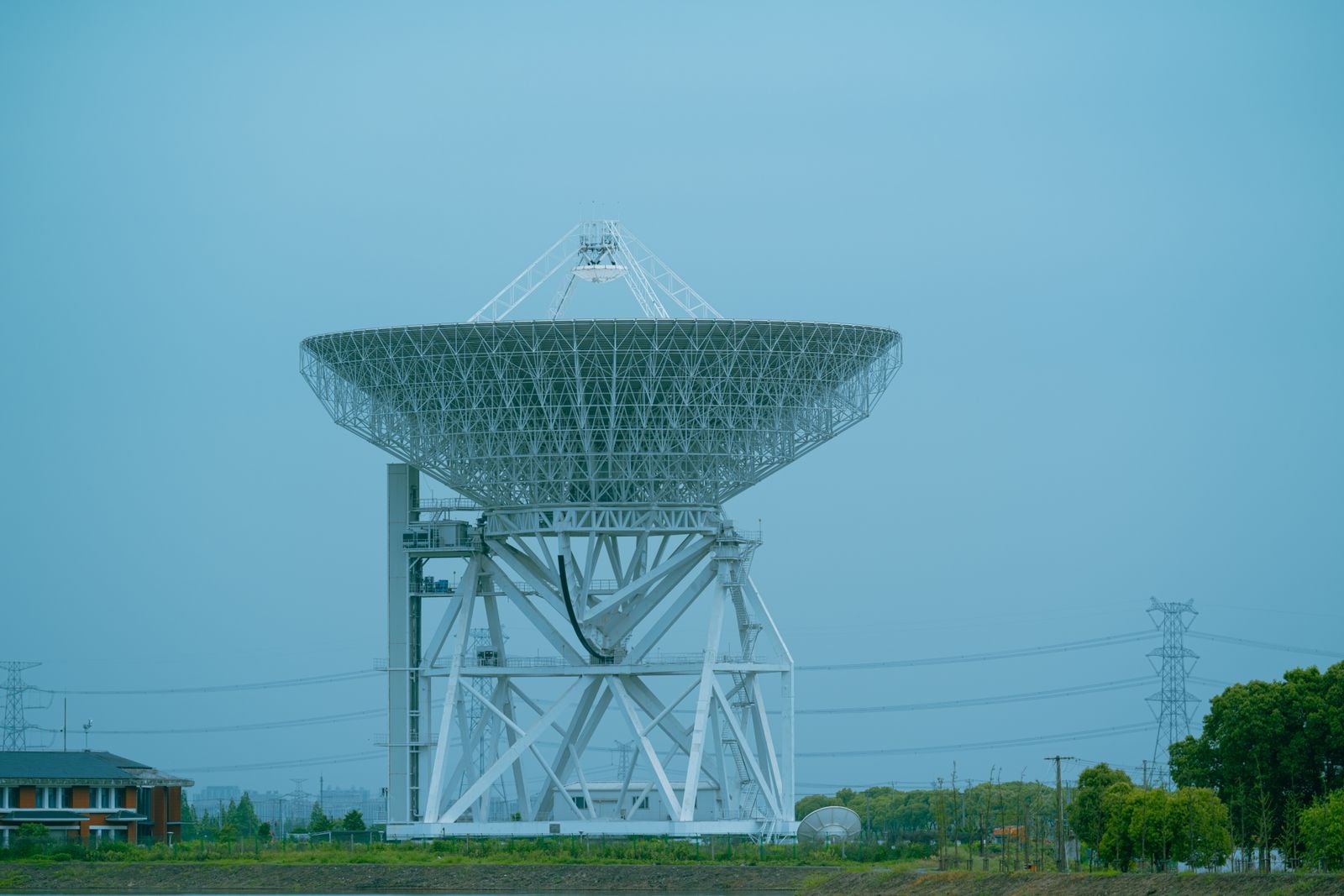
The Deep Space Network is a set of three antenna complexes, roughly 120 degrees apart in longitude — Goldstone in California, Madrid in Spain, and Canberra in Australia — so that at least one is always facing deep space as the Earth rotates. Each site has a 70-metre dish and several 34-metre dishes. The 70-metre dishes began life as 64-metre antennas in 1966, built to track Mariner 4’s flyby of Mars rather than the later Viking landers, and were enlarged to their current 70 metres between 1982 and 1988 specifically so they could handle Voyager 2’s 1989 encounter with Neptune.
Voyager 1 and Voyager 2 do not share the same patch of sky. After its final planetary encounter, at Titan, Voyager 1 bent north and now sits about 35 degrees above the ecliptic, the plane most planets orbit in — squarely in view of the Deep Space Network’s Northern Hemisphere sites at Goldstone and Madrid. Voyager 2 went the other way: its Neptune flyby sent it about 48 degrees south of the ecliptic, hidden from every antenna except the 70-metre dish at Canberra, DSS-43. That distinction matters, because when DSS-43 went offline for eleven months of upgrades in 2020, it was Voyager 2 that NASA could still hear but not command — Voyager 1 kept receiving instructions the entire time, through its own line to the northern dishes. JPL described the Voyager 2 situation plainly in a 2020 release.
To pull the signal out of the noise, the receivers cool their front-end amplifiers with liquid helium to bring thermal noise close to the physical floor, integrate the signal over long periods, and use error-correcting codes designed for exactly this regime. The data rate the ground can recover from Voyager 1 today is about 160 bits per second for science telemetry. Not kilobits. Bits. A single low-resolution photograph, at that rate, would take hours.
Why the transmitter still works at all
Voyager 1 does not run on solar panels. At its distance from the Sun, sunlight is roughly 1/26,000th of what reaches Earth, and photovoltaics would be useless. Its power comes from three radioisotope thermoelectric generators, or RTGs, each containing pellets of plutonium-238 dioxide. The heat of radioactive decay is converted directly into electricity by thermocouples.
Plutonium-238 has a half-life of about 87.7 years. At launch the three RTGs produced roughly 470 watts of electrical power between them. The isotope decays, and the thermocouples themselves degrade, so the output falls by around four watts a year. According to the mission’s own spacecraft page, Voyager 1 now has to run on under half of its original power budget, which is why instruments have been switched off one at a time over the past decade.
The transmitter has stayed on because it is the only instrument that matters if the spacecraft is going to be a spacecraft at all. Everything else — the plasma wave subsystem, the magnetometer, the cosmic ray detector — feeds through it.
The 2023 glitch, and what the record actually shows
In November 2023, Voyager 1 stopped sending readable science and engineering data. The carrier signal was still there; the telemetry inside it was gibberish. For months the spacecraft was, in effect, humming at Earth without saying anything.
The team at JPL eventually traced the fault to a single failed chip in one of the flight data subsystem’s memory banks, which had corrupted part of the software that packages telemetry for transmission. A NASA update in April 2024 described how engineers relocated the affected code to other parts of the memory and coaxed the spacecraft back into sending usable data. The turnaround for each attempted fix was about 45 hours — 22 and a half hours out, 22 and a half hours back — which is closer to sending a letter than debugging a computer.
The point worth sitting with is that the diagnostic work was done on a 1970s computer architecture, in a codebase last meaningfully rewritten before most of the engineers involved were born, from memory dumps arriving one bit at a time across interstellar space. It worked.
What the “whisper” metaphor gets right and wrong
The image of a distant whisper is close enough to be useful but slightly misleading. Voyager 1’s signal is not weak because the transmitter is failing; it is weak because it has been spread across an enormous volume of space. Any 22-watt X-band transmitter, if you put it 25 billion kilometres away and pointed it at Earth, would arrive at roughly the same level. The Deep Space Network is not straining to hear a dying radio. It is doing routine physics at the edge of what antennas, cryogenics, and coding theory allow.
What is actually running out is power, not signal. When the RTGs can no longer supply enough electricity to keep the transmitter and its heaters warm, the spacecraft will fall silent. The spacecraft’s instruments were originally designed to operate no colder than about −35°C, though individual components have kept working well past that design floor as their heaters were switched off to save power. NASA’s public planning documents have long suggested the transmitter itself will go dark sometime in the late 2020s or around 2030, depending on which instruments are shed and when.
What survives when it stops
Voyager 1 will keep moving after the radio dies. It is on a hyperbolic trajectory out of the solar system and is not aimed at anything in particular; the nearest stellar encounter of note is a pass within about 1.6 light years of the star Gliese 445, in roughly 40,000 years. The golden record bolted to its side is not really a message so much as a gesture — a set of images, sounds and greetings assembled by a committee led by Carl Sagan in 1977, on the assumption that anything capable of finding the spacecraft and reading the record would already know far more than the record could tell it.
Long after the 22 watts have gone, the harder engineering fact will still be true. For about half a century, a machine the mass of a small car ran on the heat of decaying plutonium and talked to Earth through dishes an ocean apart, using less power than the light inside a kitchen appliance, from a distance where its own signal arrived a billion billion times fainter than it left.
The next few years of the Deep Space Network schedule will show how much longer that stays true.